
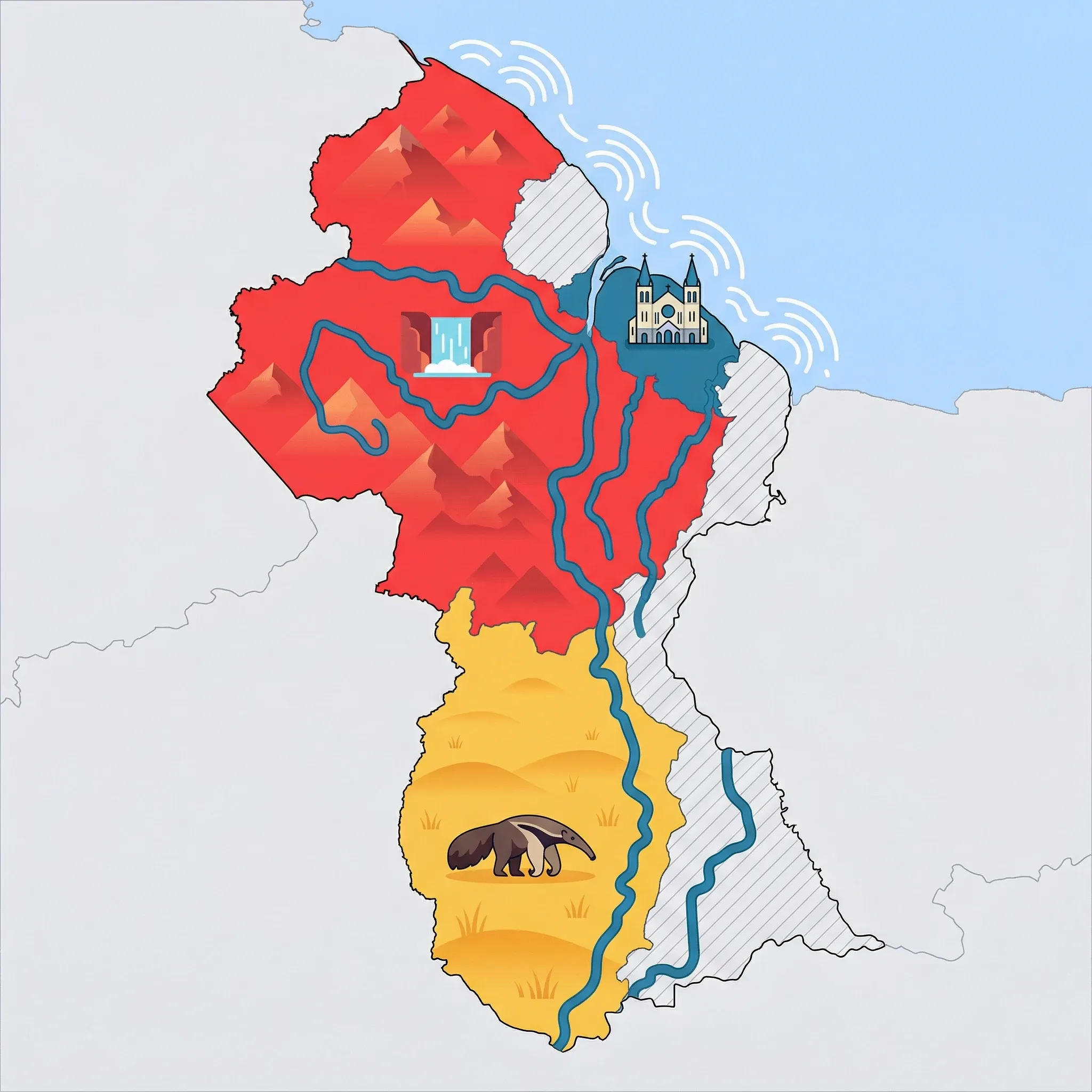
Click a region to explore
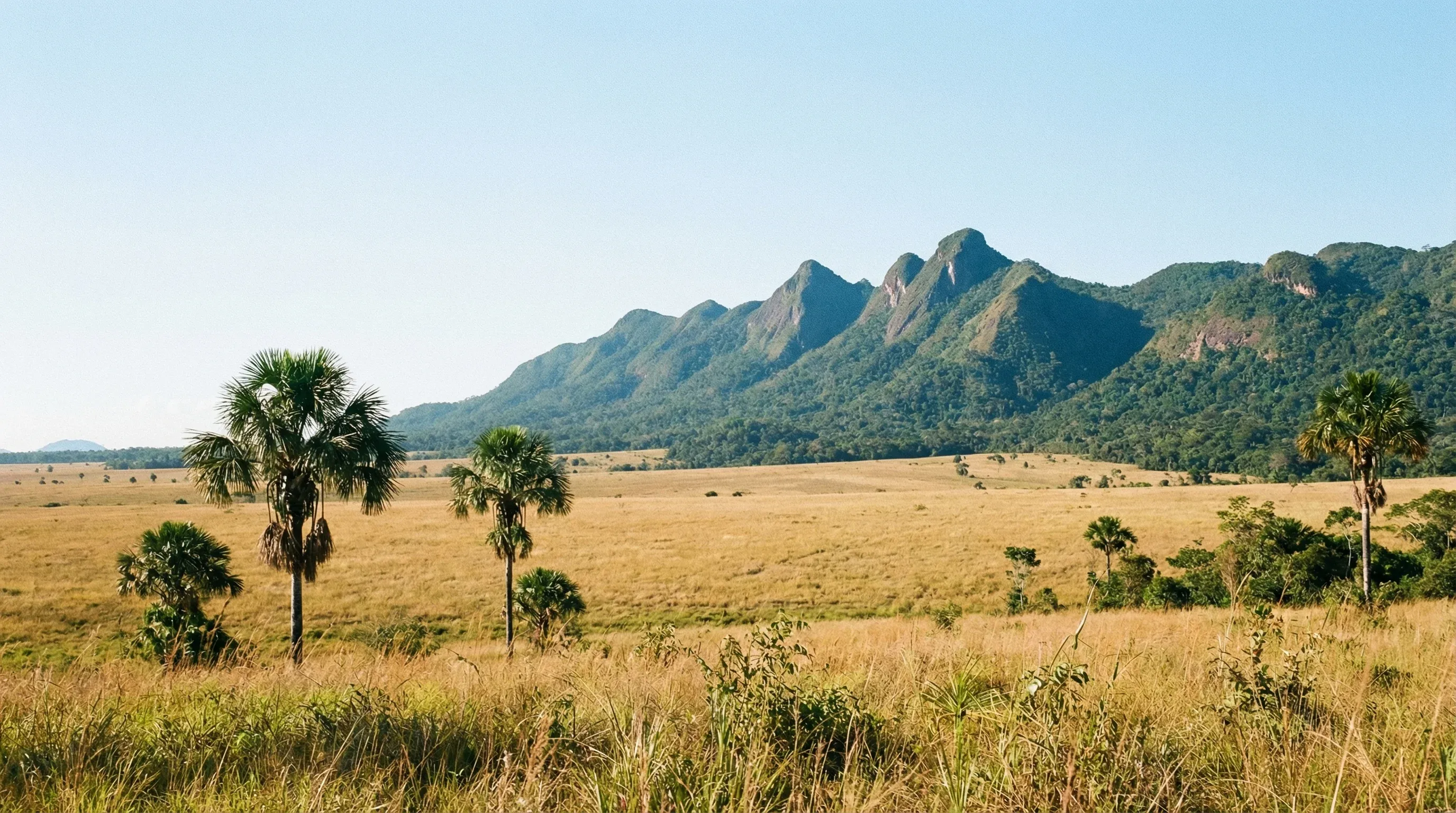
The Rupununi Savannah offers a landscape that feels more like the plains of Africa than the dense jungles of South America, yet it sits right on the edge of the Amazon. This vast region in southwestern Guyana is divided into the North and South Rupununi by the Kanuku Mountains. For families, it is the ultimate wildlife destination. The open grasslands make spotting animals far easier than in the dense rainforest. Here, you have a genuine chance of seeing giant anteaters roaming the plains, giant river otters playing in the creeks, and the majestic harpy eagle perched in the trees.
Culturally, the Rupununi is rich with Indigenous heritage. The region is dotted with Makushi and Wapishana villages that have pioneered community-led tourism. This means families don't just visit a hotel; they stay within communities, learning how to shoot a bow and arrow, how to process cassava, and listening to ancient stories under a blanket of stars that city kids can only dream of. The dry season transforms the wetlands into manageable ponds, concentrating fish and caimans, while the wet season turns the area into a massive inland sea, best explored by boat. It is rugged, remote, and utterly captivating for adventurous children.
Key Attractions
A standout experience for families is Surama Village Eco-Tourism. Surama is widely regarded as a model for community-based tourism. Staying here allows families to sleep in traditional benabs (thatched huts) and wake up to the sounds of the jungle. Guides from the village take children on nature walks to spot monkeys and birds, offering a personal and culturally immersive perspective on the land. It’s education disguised as high adventure.
Dominating the horizon are the peaks of the Kanuku Mountains Protected Area. These mountains are known locally as the 'Mountains of Life' due to their incredible biodiversity. While summiting might be too much for small legs, the foothills offer accessible trails and river trips where the mountains provide a dramatic scenic backdrop. The area is a sanctuary for some of Guyana's most elusive wildlife, including the jaguar, making every boat trip or drive a thrilling game of 'spot the animal' for kids.
Practical Advice
The Rupununi is remote. Malaria prophylaxis is generally recommended (consult a doctor). The best time for wildlife viewing is the dry season (September to April). Travel involves small planes and bumpy 4x4 rides, so it is best suited for children aged 6+ who can handle rough travel. Internet access is very limited or non-existent in many lodges.
Food & Drink
Typical meal times: Breakfast 6:30 am to 8:00 am (for early wildlife viewing). Lunch 12:00 pm to 1:30 pm. Dinner 7:00 pm to 8:30 pm.
Typical meal costs: Meals are typically all-inclusive at lodges. Independent meals in Lethem cost $2,500–4,500 GYD (approx. $12–21 USD / €11–20 EUR).
Dietary requirements: Lodges rely on local produce (cassava, river fish, local poultry). Vegetarian options are usually available (rice, beans, vegetables) but variety can be limited. Nut allergies can be managed, but always inform lodges in advance.
Signature dishes:
- Farine – A granular, couscous-like side dish made from cassava, toasted until hard and nutty. It is the staple carbohydrate of the savannah.
- Tuma Pot – A traditional Indigenous soup where meat or fish is boiled in cassava water and peppers, preserved without refrigeration.
- Roast Paca – Also known as 'labba', this is a local game meat often served in stews or roasted (though conservation-minded tourists may prefer chicken).
Why this score?
This region offers a true 'wild west' experience with vast grasslands, indigenous-led eco-lodges, and 4WD travel across rugged terrain. Families can engage in giant anteater spotting and ranching activities in one of the most sparsely populated areas of South America.
Why this score?
While the border town of Lethem has a small hospital, medical services throughout the wider savannah are extremely limited and difficult to access. Foreign visitors are far from advanced care, making medical insurance with evacuation coverage essential for this region.
Why this score?
The Rupununi is an emerging eco-tourism destination that appeals to birdwatchers and wildlife enthusiasts but sees significantly fewer visitors than Georgetown or Kaieteur. Its remote location on the Brazilian border makes it a specialized stop for dedicated nature travelers rather than general tourists.

The Rupununi is a high-cost destination due to its remoteness. All-inclusive lodge packages typically cost $50,000–85,000 GYD (approx. $235–400 USD / €220–375 EUR) per person per night. Flights from Georgetown to Lethem are approx. $60,000–70,000 GYD (approx. $280–330 USD / €265–310 EUR) return. While expensive, the cost supports indigenous communities and conservation.

Getting Here & Around
Getting Here
- Airports – Daily flights run from Ogle Airport (OGL) in Georgetown to Lethem (LTM). Flights also serve the Surama Village Eco-Tourism airstrip and Annai on specific schedules.
- Driving – It is possible to drive from Georgetown to Lethem via the Linden-Lethem trail. However, this takes 12–15 hours on rough unpaved roads and is not recommended for families unless part of a specialized 4x4 expedition.
Getting Around
- 4x4 Vehicle – The primary way to move between lodges and villages. Roads are dirt tracks that can become muddy swamps in the rainy season.
- Boat – Essential for exploring the wetlands and rivers, especially near the Kanuku Mountains Protected Area.
No airports in this region. See the country flight map for nearby connections.
Official Links

Packing List
Electricity is solar and limited; red light helps you see wildlife at night without scaring it.
The savannah sun is relentless and shade is scarce during 4x4 transfers.
Essential for tucking trousers into to prevent tick and sandfly bites in the grass.
Lodge generators often turn off at night; keeps devices charged for photos.
Extreme humidity can damage cameras and phones; keep electronics in sealed bags with these.
Essential for spotting caiman and nocturnal wildlife without frightening them.
Treat clothing before travel to repel ticks and chiggers, common in the savannah grass.
Protect gear during frequent river crossings and sudden tropical downpours.
The combination of tropical heat and humidity can cause rapid dehydration in children.
Even for kids, these are vital for seeing birds and monkeys high in the rainforest canopy.

Activities & Best Times

Hiking, wildlife, outdoor exploration, ecotourism
A premier global destination for wilderness immersion, featuring rare megafauna like giant otters and jaguars across pristine savannahs and the Kanuku Mountains. Peak visitation coincides with the long dry season when wildlife congregates at receding water sources and jungle trails remain accessible for trekking.

Sport tourism, fitness activities, active recreation
Features distinctive gravel cycling routes across the open savannah and challenging mountain treks like Makarapan, supported by community eco-tourism centers. Activities are concentrated in the dry months to ensure safe trail conditions and reliable transport between remote village bases.

Urban tourism, museums, historical sites, architecture
Focuses on authentic Macushi and Wapishana Indigenous heritage at Annai and the Bina Hill Institute, alongside the unique border culture of Lethem. These cultural hubs are best experienced during the dry season when community access and regional travel are most reliable.

Scenic drives, countryside tours, route-based travel
The Linden-Lethem Road and South Rupununi Safari routes offer iconic, rugged overland adventures through dramatic tropical landscapes. These routes are strictly seasonal, as heavy rains between May and August often render the unpaved savannah sections impassable for standard vehicles.




Public Holidays & Calendar Next 12 months
Public holidays, festivals, cultural celebrations, and seasonal natural phenomena coming up in Rupununi Savannah over the next 12 months.
Loading holidays and events...

Travel Advisory
The majority of international agencies recommend exercising a high degree of caution in Guyana. This assessment is driven by persistent levels of violent crime and limited emergency response capabilities, though specific regional tensions near the Venezuelan border also contribute to the risk profile.
Safety Topics
Traveller Advice (3 groups)

Maintain a low profile, avoid walking or driving at night, and do not resist robbery attempts. Be especially cautious when using ATMs or visiting banks.

Individuals should consult local laws and exercise discretion, as legal protections and social acceptance vary.

Female travelers should be aware of reports of sexual assault and harassment, particularly in urban areas and at night.
Agency Summaries
New Zealanders are urged to be security conscious due to high rates of violent crime, such as carjacking and sexual assault, particularly in urban environments.
Australia recommends a high level of caution due to threats of violent crime, including armed robbery and kidnapping, as well as ongoing tensions with Venezuela.
The UK provides general guidance highlighting significant crime levels and low police capacity, while noting specific risks associated with road travel and border regions.
The U.S. Department of State advises individuals to rethink travel plans to Guyana because of common violent crime and the limited capacity of local police to manage serious incidents.
Irish citizens are advised to be extremely vigilant due to high crime rates. The government notes limited consular support as there is no permanent Irish embassy in the country.
Canadian authorities suggest travelers maintain high vigilance due to elevated levels of crime across the country and a volatile security situation along the border with Venezuela.
Information is provided for general guidance only and does not constitute travel, safety, medical, or legal advice. Conditions may change. Users are responsible for independently verifying information before travel.