
Dogon Country
Where villages cling to cliffs and stars tell stories 🧗🏿♂️✨
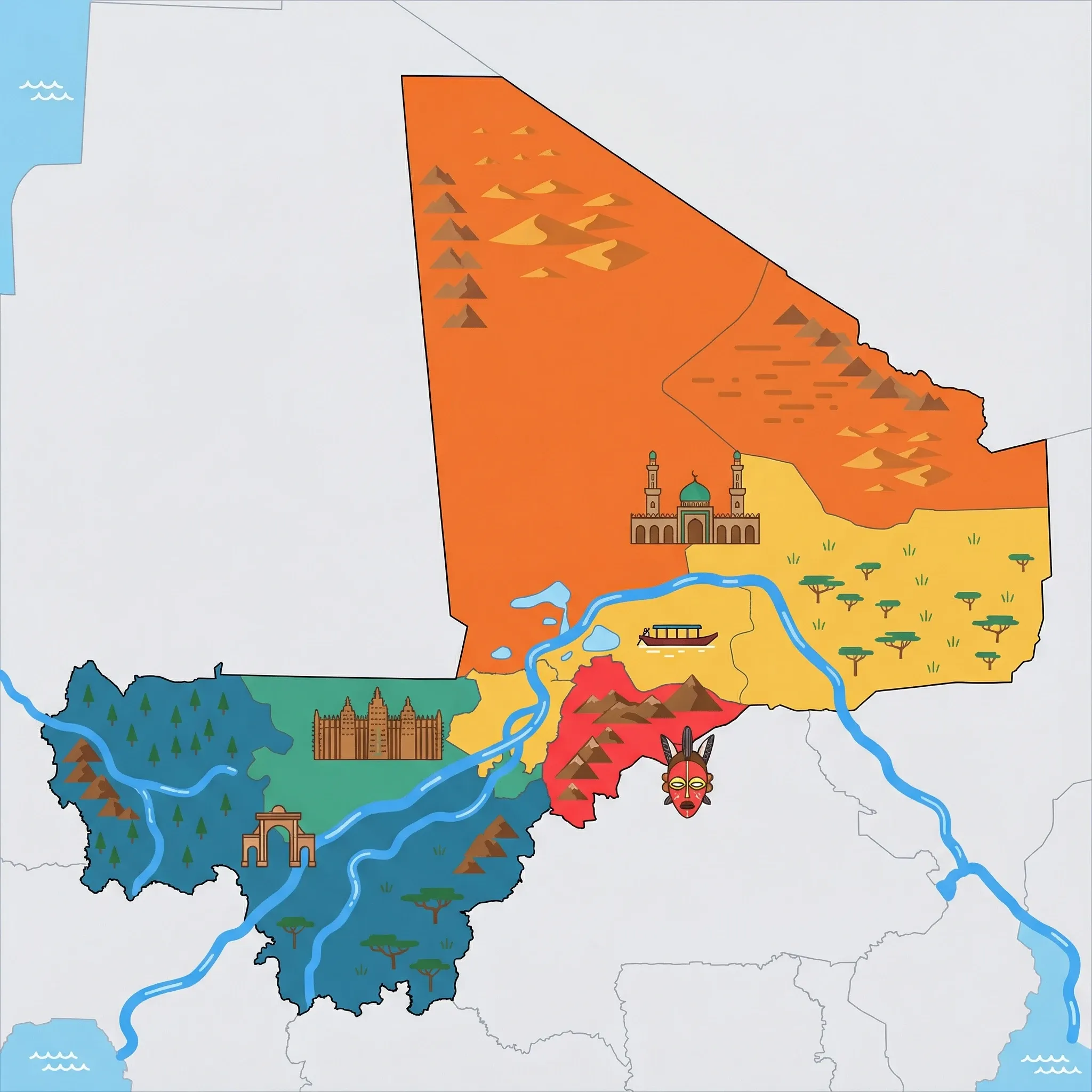
Click a region to explore
⚠️ SAFETY WARNING: Do not travel to Dogon Country. Formerly Mali's premier trekking destination, this area is now an active conflict zone involving intercommunal violence and terrorist activity. Kidnapping risks are extreme, and the region is heavily mined. Government agencies (UK, USA, CA, NZ) strictly advise against all travel here. The hiking trails and cliff villages are inaccessible to tourists.
Overview
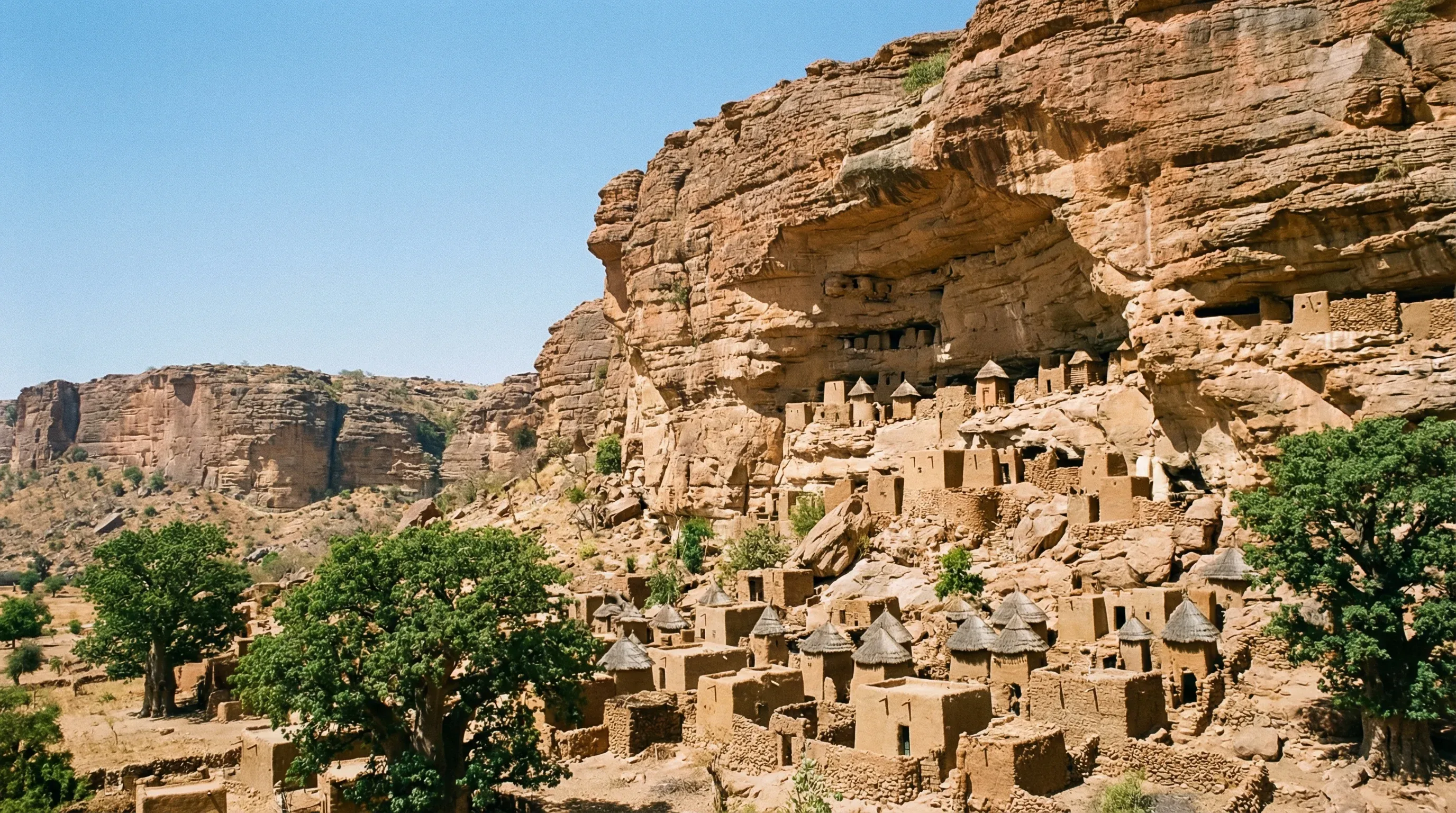
Dogon Country is a place of breathtaking geological and anthropological wonder. The region is defined by the Bandiagara Escarpment, a sandstone cliff that stretches for 150 kilometers and rises up to 500 meters high. For centuries, the Dogon people have built their villages along this cliff face, utilizing the natural defense of the terrain. The architecture is unique, with square mud granaries topped with conical straw roofs clinging to the rock like swallows' nests. In safer times, families could trek from village to village, immersing themselves in a culture that has resisted outside influence for hundreds of years.
The Dogon are renowned for their complex spirituality and cosmology, which includes detailed knowledge of the Sirius star system that predates modern astronomy. Their culture is visually expressed through intricate wooden masks and the spectacular 'Dama' funeral dances, where dancers on stilts perform gravity-defying feats. The landscape varies from the plateau above, the cliff face itself, and the sandy plains below (the Sénou-Gondo). It is a harsh, dry environment where water is precious, and life is dictated by the seasons. The resilience and artistry of the Dogon people make this one of the most culturally significant regions in all of Africa.
Key Attractions
The primary attraction is the landscape itself, specifically the Cliffs of Bandiagara. This UNESCO World Heritage site is both a natural wonder and a cultural museum. The cliffs house the Tellem structures—dwellings of a pygmy-like people who inhabited the rocks before the Dogon, now used as burial caves high up the sheer faces. Villages like Sangha and Banani are famous for their traditional architecture and the presence of the 'Hogon'—the spiritual leader of the community who lives in seclusion. Exploring the ravines and hidden waterfalls of the escarpment offers a hiking experience that combines physical challenge with deep historical discovery.
Practical Advice
Travel here is strictly for the cooler months (November to January). By April, the heat reflected off the canyon walls is unbearable (often exceeding 45°C/113°F). Trekking here requires a high level of fitness and agility. If tourism were operational, hiring a local guide would be mandatory, not just for navigation, but to navigate the complex cultural taboos and greetings required when entering villages.
Food & Drink
Typical meal times: Meals are communal and eaten when the work is done. Lunch is around 1:00 pm, and dinner is late, around 8:00 pm.
Typical meal costs: In village camps, meals are often included in lodging prices. Standalone meals are cheap: 1,500–3,000 XOF (approx. $2.50–5.00 USD / €2.30–4.60 EUR).
Dietary requirements: The diet is extremely simple, based on millet and sorghum. Vegan options are the default (millet porridge), but variety is non-existent. Gluten is the staple calorie source.
Signature dishes:
- Tô – A thick, dough-like porridge made from millet or sorghum flour, dipped in a sauce made from baobab leaves or okra. It is the fuel of the Dogon people.
- Onion Sauce – Dogon Country is the onion capital of Mali. A sweet, caramelized onion sauce is a common accompaniment to rice or couscous.
- Koni – A local beer made from millet, fermented in clay pots, often consumed during festivals.
Why this score?
The region is defined by physically demanding multi-day treks along a massive sandstone cliff and vertical climbs to ancient granaries. The remote location and traditional lifestyle of the Dogon people offer a high-intensity, off-the-grid adventure experience.
Why this score?
Facilities in the rural villages of the escarpment are virtually non-existent for anything beyond basic first aid. The rugged terrain and distance from the capital make emergency medical response or transport nearly impossible for tourists.
Why this score?
Once West Africa's top cultural destination, the Bandiagara Escarpment is now largely avoided by international tourists due to frequent security incidents and travel bans. The flow has shifted from thousands of trekkers annually to a mere handful of risk-tolerant travelers.

This is a subsistence farming region. Costs are minimal but amenities are non-existent. A guide and porter team would typically cost 15,000–25,000 XOF (approx. $25–40 USD / €23–38 EUR) per day. Accommodation is usually in basic rooftop mud huts or camping.

Getting Here & Around
Getting Here
- Road – Access is traditionally via the town of Mopti or Sevare, followed by a 4x4 drive to Bandiagara or Sangha. The roads are rough and currently plagued by security threats.
Getting Around
- Walking – The only way to see the cliff villages properly is on foot. Trails are steep, rocky, and involve scrambling over boulders.
- Donkey – For children or supplies, donkeys are the primary mode of transport up and down the escarpment.
No airports in this region. See the country flight map for nearby connections.
Official Links

Packing List
Dehydration is a severe risk due to extreme dry heat and hiking exertion.
The terrain involves sharp rocks and steep scrambling; sneakers are insufficient.
Villages have little to no electricity; charging phones or cameras is impossible otherwise.
Cola nuts (purchased locally) are a mandatory cultural offering when entering a village.
Power outages are frequent in Bamako and almost guaranteed elsewhere; street lighting is minimal.
Credit cards are virtually useless outside top hotels; ATMs are unreliable. Euros exchange easily.
Tap water is unsafe. Bottled water is available but a backup purification method is essential for emergencies.
Physical proof of vaccination is strictly checked at the airport border control upon arrival.
Extreme heat and potential stomach bugs make dehydration a rapid risk for children.
Mali is conservatively Muslim; covering shoulders and knees is respectful and avoids unwanted attention.

Activities & Best Times

Urban tourism, museums, historical sites, architecture
A UNESCO World Heritage site of unparalleled cultural depth, featuring the living heritage, unique mud-brick architecture, and sacred sites of the Dogon people. The cooler dry season is the premier window for exploring these historic villages; the pre-monsoon heat (March-May) and mid-summer rains create challenging conditions for cultural tours.

Hiking, wildlife, outdoor exploration, ecotourism
The Bandiagara Escarpment provides a globally unique landscape for immersive trekking between remote cliffside villages and the Sénou Gondo plain. Peak months offer the most comfortable temperatures for physical exploration, while the extreme heat of the Sahelian spring and the peak monsoon rains in August degrade the experience.

Sport tourism, fitness activities, active recreation
Recognized for established long-distance trekking routes that navigate the challenging vertical terrain of the Bandiagara cliffs. These routes are only viable during the cooler winter months; the extreme heat of the spring and the slippery conditions of the rainy season make strenuous activity unsuitable.

Scenic drives, countryside tours, route-based travel
The Route des Dogons and escarpment drives offer dramatic vistas, though limited infrastructure makes this more of a transit experience than a world-class touring route. Travel is best in the dry season to avoid impassable unpaved roads during the heavy rains of July and August.




Public Holidays & Calendar Next 12 months
Public holidays, festivals, cultural celebrations, and seasonal natural phenomena coming up in Dogon Country over the next 12 months.
Loading holidays and events...

Travel Advisory
All major international travel agencies maintain their highest risk rating for Mali, advising against all travel due to extreme security threats including terrorism, kidnapping, and civil instability.
Safety Topics
Traveller Advice (2 groups)

Anyone currently in the country should leave immediately via commercial air travel while it remains available. If you must stay, maintain a personal emergency plan and consider hiring professional security services.

Aid workers face a critical risk of kidnapping for ransom by extremist groups. Operations outside of Bamako are extremely dangerous and lack government protection or support.
Agency Summaries
U.S. authorities recommend against any travel due to extreme levels of violent crime, terrorism, and kidnapping. While embassy operations have been normalized, government personnel are strictly limited to the capital, and help outside Bamako is unavailable.
The Irish Department of Foreign Affairs strongly advises against all travel. With no local embassy presence, the ability to provide emergency consular assistance is severely limited, and citizens are urged to leave via commercial air routes.
Australia urges citizens to avoid Mali entirely. There is a very high danger of terrorist activity and kidnapping throughout the country. Australians already present should consider departing while commercial flights are still operational.
The Canadian government warns against all travel to Mali because of persistent threats from terrorist organizations, high kidnapping risks, and widespread banditry. Recent fuel shortages have further complicated domestic transportation and essential services.
New Zealand classifies Mali as a no-travel zone due to extreme insecurity, violent banditry, and the threat of terrorism. The withdrawal of international peacekeeping forces has increased regional instability and risks for foreigners.
The FCDO advises against all travel to Mali citing highly unpredictable security and a significant threat of kidnapping. Militant blockades on major roads and fuel supply routes have increased risks for those attempting to travel by land.
Information is provided for general guidance only and does not constitute travel, safety, medical, or legal advice. Conditions may change. Users are responsible for independently verifying information before travel.