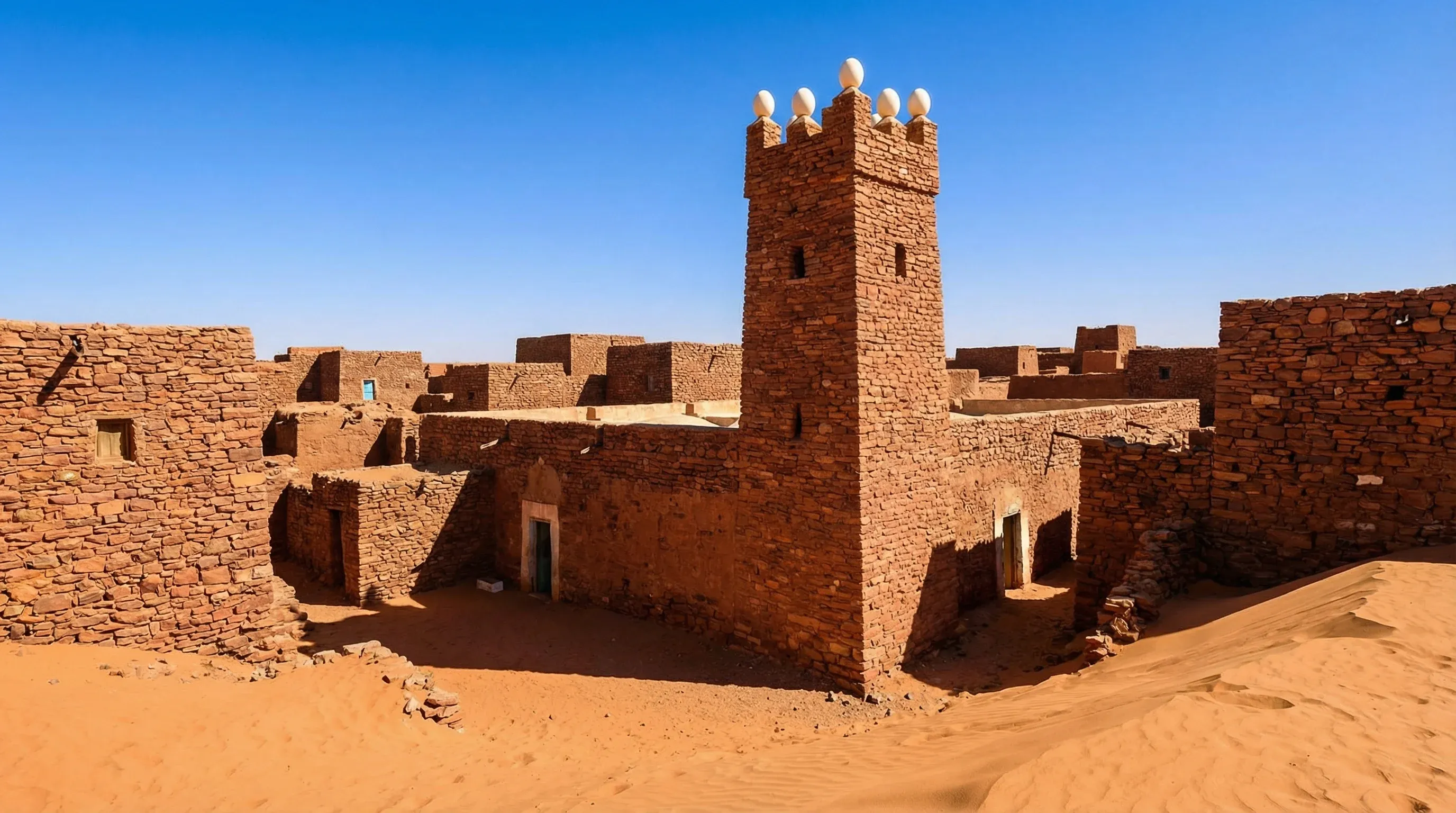

Chinguetti & Adrar (desert)
Ancient cities hidden in the golden dunes 🐪📜
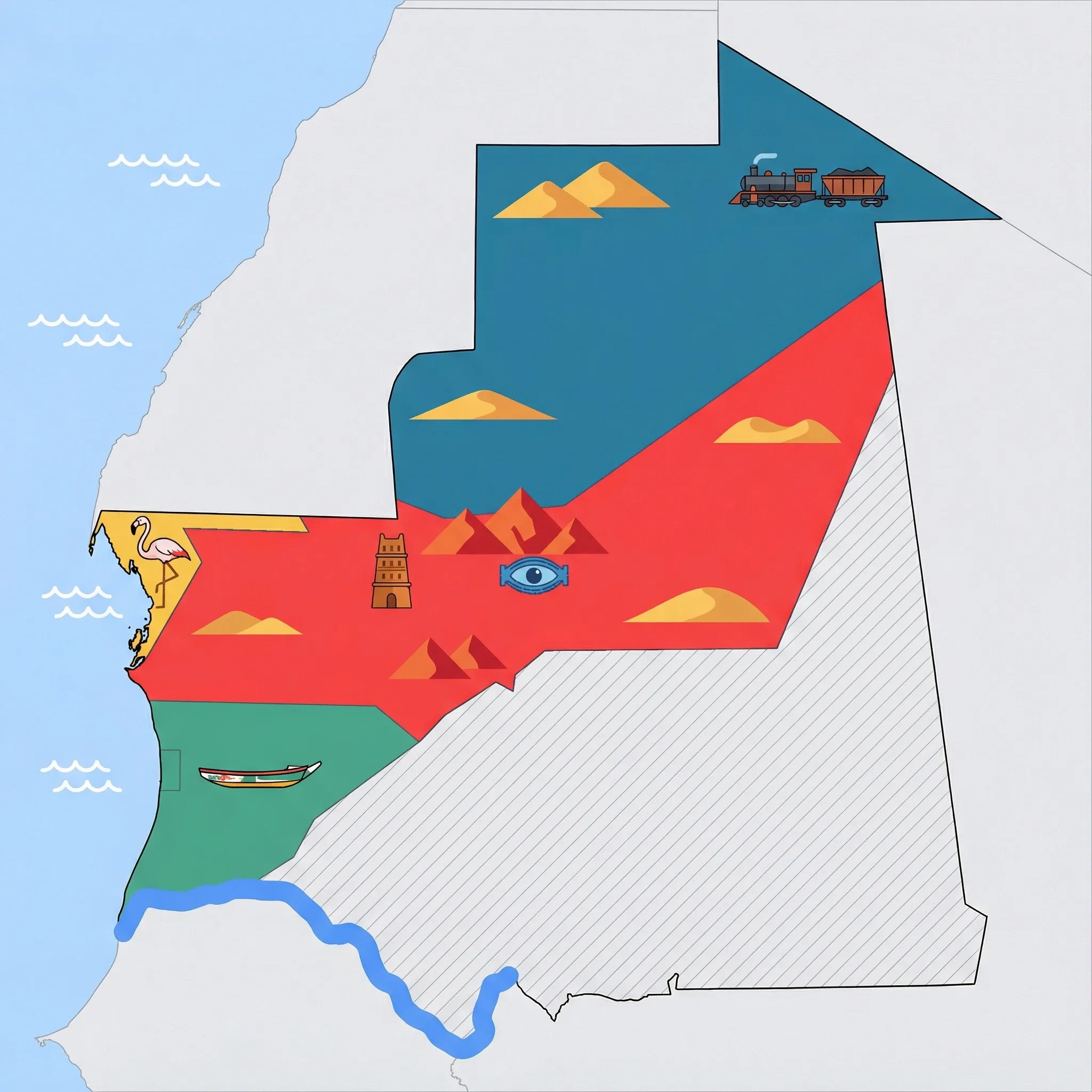
Click a region to explore
⚠️ SAFETY WARNING: Government agencies (including the UK, USA, CA, and AU) advise travelers to reconsider travel to this region due to the risk of kidnapping and the remote nature of the terrain. While the Adrar region has been secured by tourism police and is a popular zone for guided tours, the risk remains elevated compared to global standards. Travel east of Chinguetti towards the Mali border is strictly advised against. Families should only visit as part of a professionally organized convoy with security clearance.
Overview
The Adrar region is the Mauritania of the imagination: endless undulating dunes, rocky plateaus that look like Mars, and green oases hiding in deep canyons. For families with a sense of adventure, this is one of the world's great desert playgrounds. The history here is palpable. Known as the "Sorbonne of the Desert," the ancient towns served as vital stops for camel caravans carrying gold, salt, and scholars across the Sahara. The silence of the desert is profound, and the nights offer stargazing opportunities that are unrivaled, with the Milky Way visible clearly to the naked eye.
Culturally, this region introduces children to the Nomadic way of life. Hospitality is a sacred duty here; families will likely be invited to sit on mats, drink foam-topped mint tea, and eat fresh dates. The pace is slow, dictated by the sun and the prayer calls echoing from ancient minarets. While the environment is harsh, the unexpected beauty of spots like the Terjit Oasis—where warm springs bubble out of the rock into natural swimming pools shaded by palm trees—provides a magical respite that feels like stepping into a storybook.
Key Attractions
The Ancient Ksour of Chinguetti is the crown jewel. Families can wander the narrow, sand-swept alleyways of this UNESCO site and visit traditional libraries where curators show off centuries-old manuscripts made of gazelle skin. Just peering at the Friday Mosque of Chinguetti with its iconic dry-stone minaret is a history lesson in itself. A short drive away, the colossal dunes of the Erg Warane offer incredible fun for children—running down the steep slopes or riding camels at sunset.
Further afield, the Ancient Ksour of Ouadane sits on a rocky hill, offering a more ruined, ghostly atmosphere that feels like exploring a lost civilization. For a geology lesson on a planetary scale, the Eye of the Sahara (Richat Structure) is a massive circular formation visible from space. While it's hard to grasp the full circle from the ground, the landscape of concentric rock rings is fascinating to hike through, littered with ancient stone tools and unique minerals.
Practical Advice
The travel window is strictly October to March; the rest of the year is dangerously hot. This is an expedition, not a vacation. You will spend hours in 4x4 vehicles on bumpy tracks. It is best suited for children aged 8+ who can handle car travel and heat. Hydration is critical. Accommodation ranges from guest houses (auberges) made of stone to sleeping on mats in open-air courtyards or tents.
Food & Drink
Typical meal times: Lunch is a long break from the heat (1:00 pm to 3:00 pm). Dinner is served late, often after 8:30 pm.
Typical meal costs: Meals in auberges usually cost 300–600 MRU (approx. $7.50–15 USD / €7–14 EUR). A whole roasted lamb (mechoui) for a group can cost 4,000–6,000 MRU (approx. $100–150 USD / €95–140 EUR).
Dietary requirements: The desert diet is heavy on meat (goat, camel, mutton) and starch. Vegetables are scarce and often canned. Vegetarians must inform guides in advance so they can procure supplies in Atar. Vegan options are extremely limited.
Signature dishes:
- Dates – The Adrar region produces the best dates in the country. Fresh dates (in season) or dried dates dipped in cream are a staple energy source.
- Couscous with Camel Meat – A Friday tradition. The camel meat is rich and gamey, served over large-grain couscous with a savory sauce.
- Zrig – Fermented camel milk mixed with water and sugar. It is a beloved local drink served to guests; the taste is like a thin, sweet drinking yogurt.
Why this score?
The region offers a quintessential Saharan adventure, featuring deep sand dunes, rocky plateaus, and remote oases like Terjit. Travel typically involves long 4WD expeditions, camel trekking, and camping under the stars in a harsh, arid environment.
Why this score?
The regional hub of Atar has a basic hospital and some pharmacies, but specialized care and English-speaking staff are rare. In the event of a serious injury in the dunes or ancient towns, evacuation to Nouakchott is the only viable option for modern treatment or stabilization for flight home.
Why this score?
This is the cultural heart of Mauritanian tourism, known for its ancient desert libraries and the iconic dunes of Chinguetti. Though it is the most visited area outside the capital, the total number of annual international visitors remains very low compared to global standards.

Basic costs are low, but the necessity of guides and vehicles raises the price. A room in a guesthouse costs 1,500–3,000 MRU (approx. $38–75 USD / €35–70 EUR). Car rental with a driver/guide is the biggest expense, costing around 3,000–4,500 MRU (approx. $75–115 USD / €70–105 EUR) per day plus fuel.

Getting Here & Around
Getting Here
- Airports – Atar International Airport (ATR) receives seasonal charter flights directly from Paris during winter. Otherwise, you must fly to Nouakchott (NKC) and drive.
- Driving – The drive from Nouakchott to Atar is on a paved road and takes about 5–6 hours. It is a long but scenic journey through changing desert landscapes.
Getting Around
- Car (4x4) – Essential. The road ends at Atar/Chinguetti; beyond that, you are driving on sand dunes and rocky plateaus. Only experienced desert drivers should attempt this.
- Walking – Within the old towns of the Ancient Ksour of Chinguetti and Ancient Ksour of Ouadane, walking is the only way to explore the narrow alleys.
No airports in this region. See the country flight map for nearby connections.
Official Links

Packing List
Essential for protecting face/mouth during sandstorms; buy locally but bring a scarf to start.
The combination of near-zero humidity and dust is very harsh on eyes.
Charging points in desert camps are scarce or rely on limited generators.
The extremely dry, dusty air causes blocked noses and nosebleeds in children.
Essential for protecting eyes during sandstorms or if near the dusty Iron Ore Train.
Used locally to wrap the face and head for protection against sun, wind, and sand.
Power cuts are common and desert camping is pitch black; red light preserves night vision.
Provides a clean sleeping layer when staying in basic guest houses or communal nomad tents.
Sand gets everywhere; essential for protecting phones, cameras, and documents.

Activities & Best Times

Hiking, wildlife, outdoor exploration, ecotourism
Offers world-class desert immersion including the dunes of Erg Ouaran and the unique Eye of the Sahara geological site. Exploration is only viable during the cooler winter months, as summer temperatures frequently exceed 40°C.

Urban tourism, museums, historical sites, architecture
Home to UNESCO-listed ancient ksour and historic Saharan architecture that provides a highly authentic experience for sophisticated travelers. The peak season aligns with mild temperatures suitable for walking through historic quarters like Chinguetti and Ouadane.

Scenic drives, countryside tours, route-based travel
Features iconic 4x4 desert routes and the dramatic Amogjar Pass, offering a premier Saharan driving experience. Travel is discouraged in the summer due to extreme heat and the increased risk of sandstorms and vehicle failure.

Sport tourism, fitness activities, active recreation
Renowned for multi-day desert trekking and camel expeditions along established routes between oases. The physical exertion required means that only the winter months are safe and comfortable for these activities.

Learning experiences, scientific sites, historical education
Provides rare access to medieval manuscript libraries in Chinguetti, offering profound historical insight for niche travelers. The limited facilities and lack of climate control in these historic structures make summer visitation highly uncomfortable.



Public Holidays & Calendar Next 12 months
Public holidays, festivals, cultural celebrations, and seasonal natural phenomena coming up in Chinguetti & Adrar (desert) over the next 12 months.
Loading holidays and events...

Travel Advisory
All major agencies maintain a high-level warning for Mauritania, primarily due to terrorism, the threat of kidnapping against Westerners, and violent crime. Non-essential travel is discouraged for the entire country, while large regional sections are considered too dangerous for any travel.
Safety Topics
Traveller Advice (3 groups)
Staff from international organizations are at a heightened risk of kidnapping in the eastern and northern regions. Professional security assessments and escorts are strongly recommended when operating outside Nouakchott.

Female travellers should dress conservatively and avoid moving alone, particularly after dark. There are significant legal risks when reporting sexual assault, as local laws may require victims to provide specific proof to avoid being charged with non-consensual acts themselves.

A pre-approved electronic visa is mandatory for entry; visas are no longer issued upon arrival at the border or airport. Travellers should carry multiple photocopies of their passport at all times as identity checks are frequent.
Agency Summaries
New Zealand classifies the security situation as unpredictable, citing kidnapping and terrorism as major threats. Travel to northern and eastern provinces is strongly discouraged due to armed banditry and military operations.
Canadians are advised to avoid non-essential travel due to significant threats of terrorism and kidnapping. Highest risk levels apply to northern and eastern border regions where extremist groups and bandits are active. Westerners are frequently targeted for abduction.
Australia advises a high degree of caution overall with a recommendation to reconsider travel plans due to kidnapping risks and terrorism. Violent crime is on the rise, and landmines remain a hazard near the Western Sahara border, particularly after sandstorms.
British authorities advise against all travel to eastern regions and border zones, and all but essential travel elsewhere. There is a high risk of terrorism and kidnapping throughout the country. Civil unrest and demonstrations occur periodically in the capital.
Ireland advises against non-essential travel due to serious security concerns. Irish citizens have very limited consular support as there is no local embassy. E-visas must be obtained online prior to departure.
The U.S. government recommends reconsidering travel because of crime and terrorism. Violent crimes like armed robbery and assault are common. Military-restricted zones in the north and along the Mali/Algeria borders are extremely dangerous and off-limits to visitors.
Information is provided for general guidance only and does not constitute travel, safety, medical, or legal advice. Conditions may change. Users are responsible for independently verifying information before travel.