
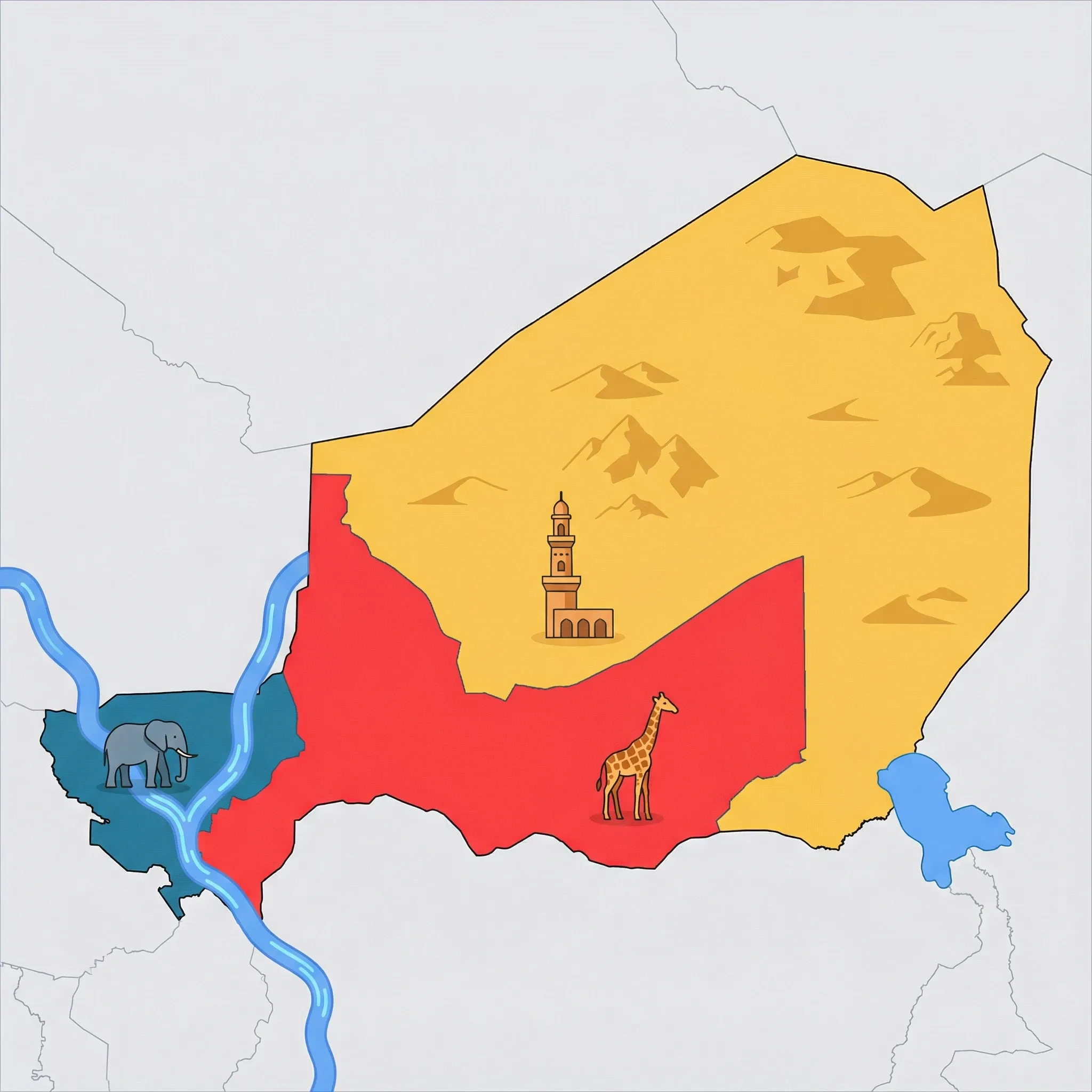
Click a region to explore
⚠️ SAFETY WARNING: Due to the extreme risk of terrorism, kidnapping, and remote desert conditions, government agencies (including CA, USA, UK, AU, IE, and NZ) advise travelers to avoid all travel to the Agadez and Sahara region. The area sees active militant presence, and emergency assistance is nearly impossible to obtain in the deep desert. Families are strongly urged to consult their own government's official travel advisory before considering a trip, as this region is currently classified as a maximum-risk zone.
Overview
Agadez was historically the vibrant capital of the Tuareg people and a crucial stop on trans-Saharan trade routes. The city itself is a UNESCO World Heritage site, famous for its labyrinthine streets and red clay architecture that seems to rise organically from the desert floor. For families fascinated by history, the region represents one of the world's most dramatic intersections of human endurance and harsh geography, though it is currently only safe to explore through documentaries and literature.
Beyond the city lies the Ténéré, often called the "Desert of Deserts," a vast expanse of shifting dunes and stark beauty. The Aïr Mountains provide a dramatic volcanic backdrop, creating oases like Timia where citrus fruits grow against all odds. While the current security situation precludes family holidays, the region remains culturally significant for its nomadic traditions, camel caravans, and the annual gathering of clans known as the Cure Salée.
Key Attractions
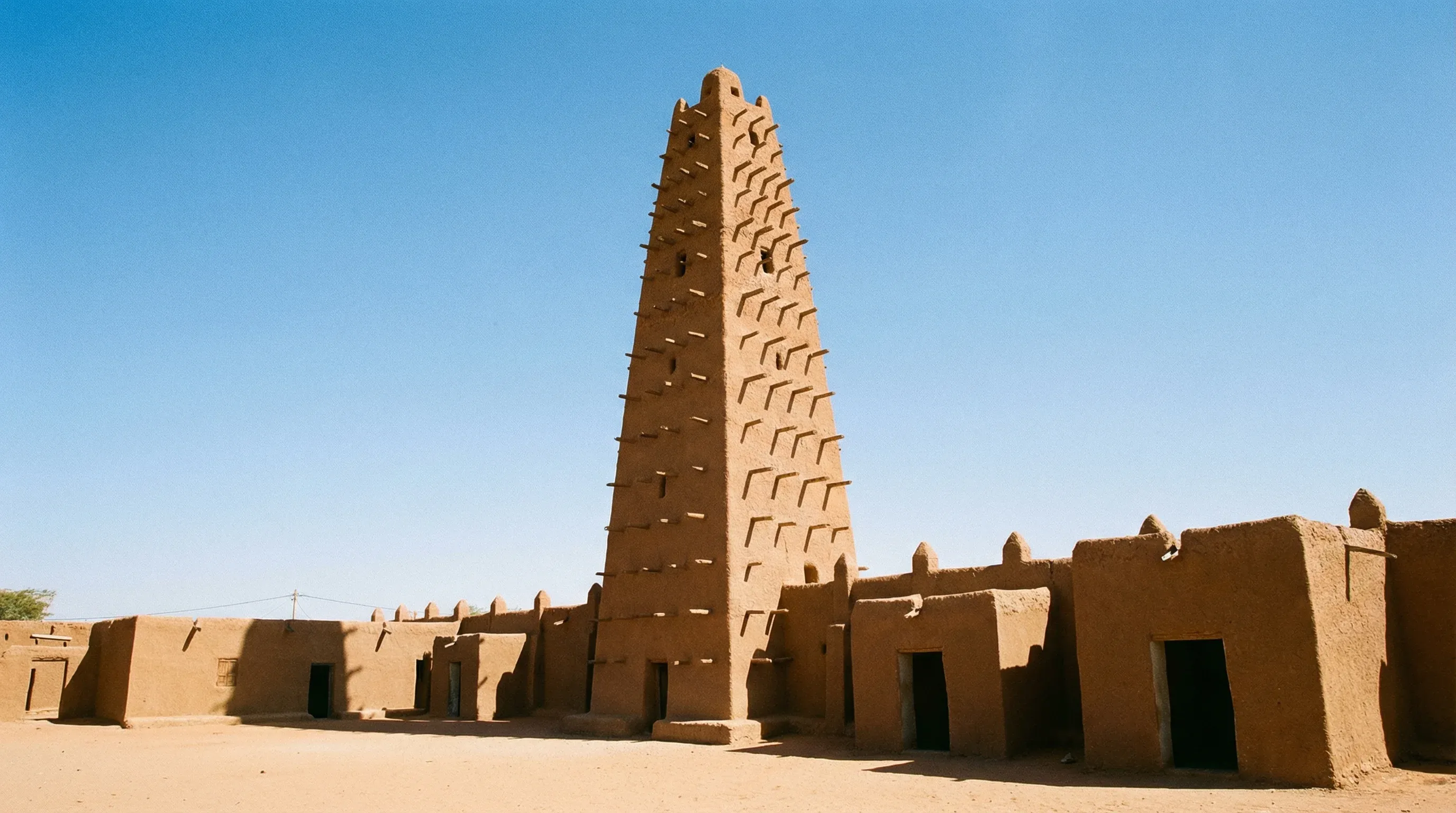
The skyline of the region is dominated by the Agadez Grand Mosque. It is the tallest mud-brick structure in the world, standing as a beacon for caravans for centuries. Children are often captivated by the story of its construction, made entirely of clay, wood, and straw, requiring constant community maintenance to survive the elements.
Deep in the desert, the Dabous Giraffe Petroglyphs offer a window into a prehistoric past when this arid land was green and fertile. These life-sized rock carvings of giraffes are among the finest examples of ancient rock art in the world. Further out, the Grand Erg de Bilma presents a cinematic landscape of endless sand dunes, historically crossed by salt caravans, offering a stark lesson in geography and trade.
Practical Advice
When to visit: If travel were possible, the cool season from November to February is the only tolerable time for families, as summer temperatures frequently exceed 45°C (113°F).
Logistics: Travel here historically required military escorts and convoys of reliable 4x4 vehicles due to the unforgiving terrain.
Food & Drink
Typical meal times: Lunch is usually eaten between 12:30 pm and 2:00 pm, while dinner is a late affair, often served from 8:00 pm to 9:30 pm, coinciding with cooler evening temperatures.
Typical meal costs: Basic local meals are inexpensive, costing around 2,000–4,000 XOF (approx. $3.30–6.60 USD / €3–6 EUR). However, supplies for desert expeditions are costly.
Dietary requirements: Options are extremely limited. The diet is heavy on grains (millet) and meat (goat/camel). Vegetarians would struggle significantly, and gluten-free options are virtually non-existent outside of simple rice.
Signature dishes:
- Taguella – A traditional Tuareg bread baked in the hot sand beneath the embers of a fire, often served with a meat sauce.
- Mouton Grillé – Spit-roasted sheep or goat, seasoned simply and cooked over an open fire, a staple of desert hospitality.
- Tuareg Tea – A strong, sweet green tea served in three rounds (the first bitter as death, the second mild as life, the third sweet as love), central to all social interaction.
Why this score?
The region offers some of the world's most extreme desert landscapes, including the Aïr Mountains and the vast Ténéré dunes. Navigating this terrain requires specialized 4x4 expeditions, camel caravans, and self-sufficiency in a true wilderness environment with no established amenities.
Why this score?
Medical facilities in the city of Agadez are very basic and frequently lack essential supplies or specialized personnel. Once deep in the Sahara or the Aïr Mountains, there is virtually no medical infrastructure, and emergency evacuation is extremely difficult to coordinate.
Why this score?
While Agadez is a UNESCO World Heritage site and a historic Saharan hub, severe security concerns and government travel warnings have reduced international leisure tourism to near zero. Most current visitors are limited to specialized researchers or intrepid travelers, as the infrastructure for standard tourism has largely collapsed.

While local street food is cheap, the cost of visiting Agadez as a tourist is historically high due to the logistics. A secure expedition requires hiring 4x4s, drivers, guides, and security. Expedition costs can range from 100,000–180,000 XOF (approx. $165–300 USD / €150–275 EUR) per person per day. Basic guesthouses (when open) cost around 25,000–40,000 XOF (approx. $40–65 USD / €38–60 EUR) per night.

Getting Here & Around
Getting Here
- Airports – Mano Dayak International Airport (AJY) in Agadez historically received charter flights, but commercial service is erratic or non-existent due to security.
- Driving – The road from Niamey (Route Nationale 25) is a long, arduous journey of over 900km, requiring armed escorts and passing through high-risk zones.
Getting Around
- 4x4 Expedition – The only way to traverse the Aïr and Ténéré Natural Reserves is by fully equipped 4x4 vehicles with experienced guides and satellite communications.
- Walking – Within the Agadez Historic Centre, walking is the primary mode of transport through the narrow, sandy alleyways.
No airports in this region. See the country flight map for nearby connections.
Official Links

Packing List
Essential for protecting the face and nose from blowing sand and dust storms.
The air is incredibly dry and dusty; drops prevent nosebleeds and discomfort.
There is zero cellular coverage in the Ténéré desert; essential for emergencies.
More effective than sunglasses during a sandstorm to protect eyes.
The Harmattan wind fills the air with fine desert dust (Dec–Mar), which can irritate lungs.
Power outages are frequent in Niamey and street lighting is inconsistent.
Malaria is a severe risk; hotel nets may be damaged or ill-fitting.
Credit cards are rarely accepted outside top hotels; ATMs often run out of cash.
Extreme heat causes rapid dehydration, especially in children; these are vital for recovery.
English is rarely spoken; basic French is essential for daily interactions.

Activities & Best Times

Hiking, wildlife, outdoor exploration, ecotourism
Home to the UNESCO-listed Aïr and Ténéré Natural Reserves, this region offers some of the world's most dramatic desert landscapes and mountain trekking. Visitation is strictly limited to the cooler winter months as extreme heat from May to September makes desert travel dangerous.

Urban tourism, museums, historical sites, architecture
Agadez is a legendary Saharan crossroads featuring the iconic mud-brick Grand Mosque and a vibrant Sultanate culture that remains highly authentic. The peak season aligns with cooler weather, which is essential for exploring the historic center's labyrinthine alleys and archaeological sites like the Dabous giraffes.

Events, celebrations, seasonal attractions
The Cure Salée (Festival of the Nomads) is described as 'globally significant' but rated marginal. While infrastructure challenges exist, the festival is internationally recognized and draws cultural tourism. Rating should be 'good' to reflect its genuine significance.

Scenic drives, countryside tours, route-based travel
The Ténéré desert circuits and routes through the Aïr Mountains represent one of Africa's most challenging and scenic overland journeys. While infrastructure is minimal, this is a regionally significant road trip destination that attracts serious overlanders globally. 'Marginal' undervalues the route's reputation.

Sport tourism, fitness activities, active recreation
The Aïr Mountains provide exceptional terrain for high-endurance trekking and technical ascents like Mont Bagzane. Activity is condensed into the winter window to avoid heat exhaustion, while the shoulder months are only suitable for early morning excursions.

Spa retreats, wellness centers, peaceful getaways
The Tafadek Thermal Spring offers a unique, albeit rustic, wellness experience in a remote Saharan setting. These hot springs are most enjoyable when ambient air temperatures are lower during the Saharan winter.

Attractions (9 total)



Public Holidays & Calendar Next 12 months
Public holidays, festivals, cultural celebrations, and seasonal natural phenomena coming up in Agadez & Sahara over the next 12 months.
Loading holidays and events...

Travel Advisory
All major agencies maintain their highest warning level for Niger, advising against any travel due to extreme risks from terrorism, political instability, and kidnapping. Security is highly volatile following the 2023 coup.
Safety Topics
Traveller Advice (2 groups)

Travellers are strongly discouraged from entering the country and those currently present should consider leaving via commercial means. Maintain emergency evacuation plans and a supply of essential items like water and food.
Aid workers are specifically identified as high-risk targets for kidnapping by extremist groups, particularly in rural and border regions where militant groups operate.
Agency Summaries
Ireland advises against all travel because of the unstable political climate and frequent terrorist activity. Crime levels in Niamey are high, and travelers are warned that they should be prepared to leave the country on short notice if already present.
New Zealand classifies Niger as a highest-risk destination due to the threat of armed militants and an unpredictable security situation. Violent crimes, including home invasions and carjackings, frequently target foreigners.
The FCDO strongly warns against all travel due to an increased frequency of terrorist kidnappings and the high risk of attacks in the capital, Niamey. Political conditions remain volatile, and in-person consular support is unavailable within the country.
The Canadian government advises avoiding all travel to Niger due to significant political instability following the 2023 coup and the extreme risk of terrorism and kidnapping throughout the country. Consular services are severely limited.
U.S. authorities have issued their highest warning level, ordering the departure of non-emergency staff. The advisory cites persistent threats from terrorism, violent crime, civil unrest, and kidnappings, particularly targeting Westerners and transport hubs.
Australia recommends that its citizens avoid all travel to Niger due to a dangerous security environment. There is a critical risk of kidnapping for ransom and terrorism. Foreigners are advised that the government's ability to provide assistance is extremely restricted.
Information is provided for general guidance only and does not constitute travel, safety, medical, or legal advice. Conditions may change. Users are responsible for independently verifying information before travel.