
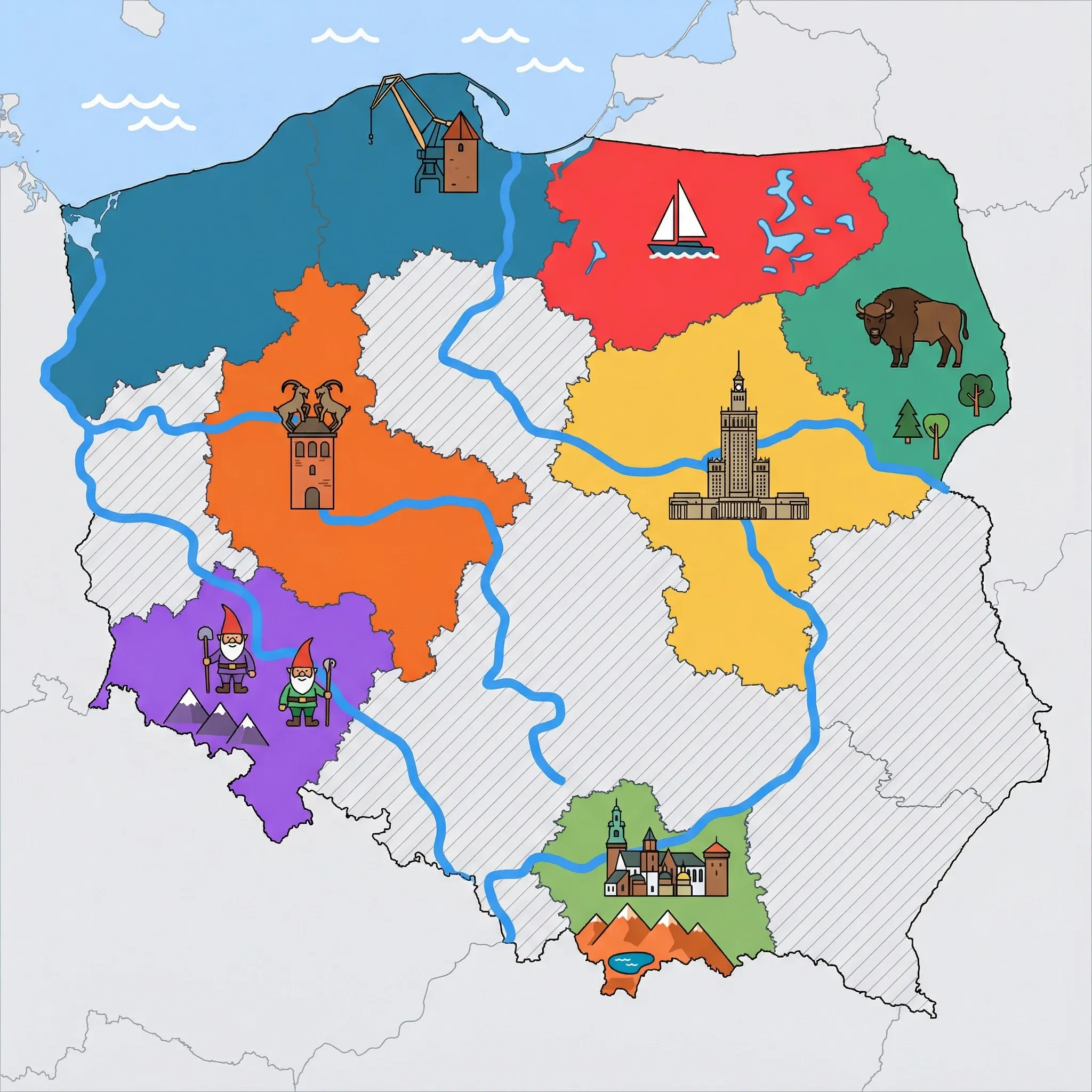
Click a region to explore
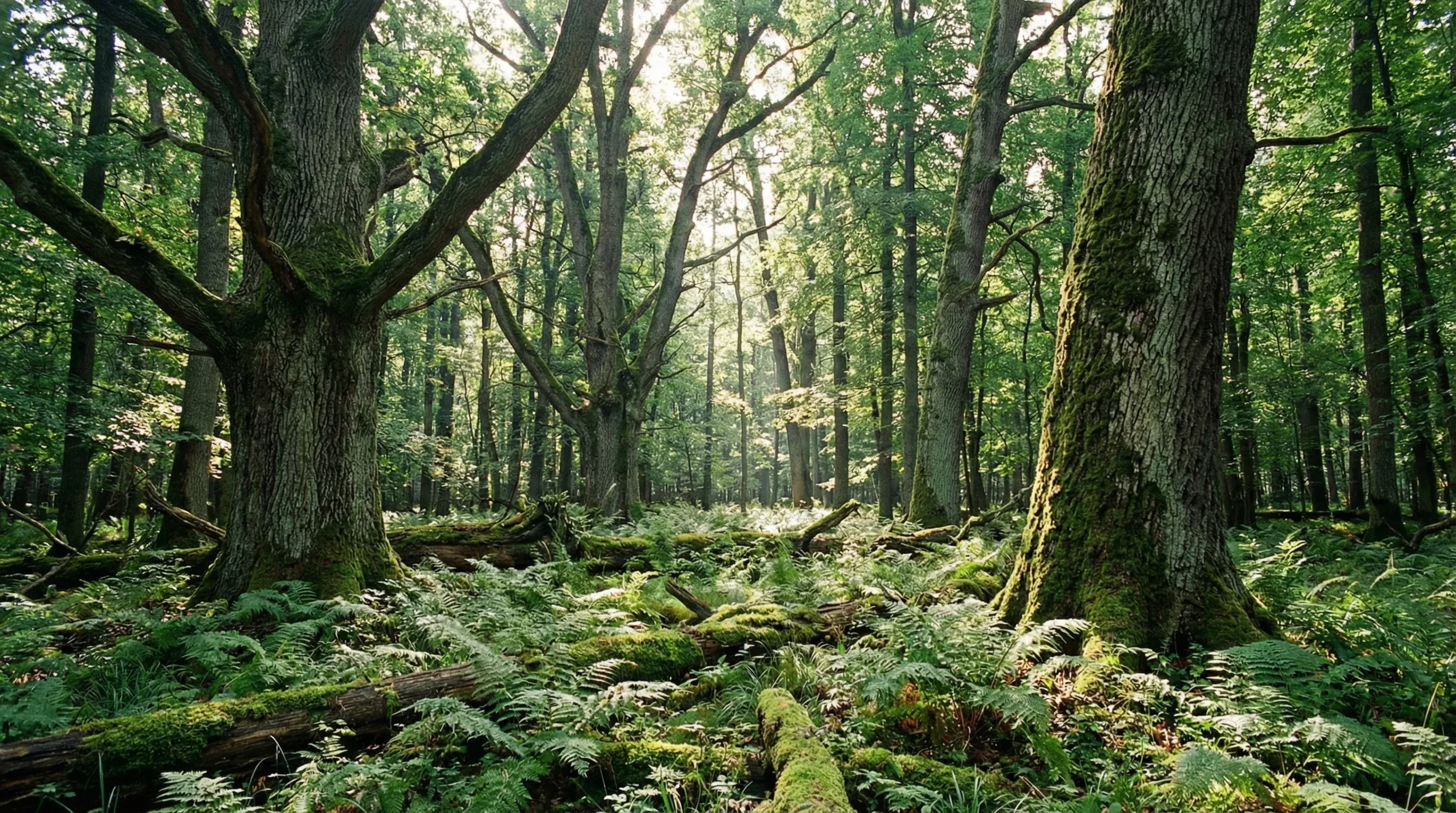
Podlasie is Poland's "Wild East," a region where time seems to slow down and nature rules supreme. It is the most culturally diverse part of the country, a melting pot of Catholic, Orthodox, Tatar, and Jewish influences, evident in the colourful wooden shutters of village houses and the onions domes of churches. For families, the headline act is the nature. This is home to the Białowieża National Park, the last fragment of the primeval forest that once covered Europe. Here, you can show your children what the continent looked like thousands of years ago—massive oaks, mossy bogs, and free-roaming European Bison (Żubr), the continent's heaviest land mammal. Tracking them in winter or visiting the show reserve is an experience kids never forget.
Beyond the forest, the region is known as the "Polish Amazon" due to the Narew River, which splits into hundreds of channels perfect for gentle kayaking and rafting trips suitable for beginners. The landscape is flat and open, dotted with storks' nests on almost every telephone pole. Podlasie is fantastic for families seeking quiet, rural tourism (agroturystyka). You can stay in traditional wooden cottages where hosts serve food straight from the garden. It is an educational journey too, teaching children about coexistence through the region's Muslim Tatar heritage and Orthodox traditions.
Key Attractions
The absolute must-do is the European Bison Show Reserve, where you are guaranteed to see bison, elk, and wolves in a natural setting. For a deep dive into the primeval forest, guided tours into the strict protection zone of Białowieża National Park are available (mandatory guide required). Culturally, driving the The Tatar Trail is fascinating; you can visit the wooden mosque in Kruszyniany and taste traditional Tatar food. In the regional capital, the majestic Branicki Palace offers a taste of Versailles-style luxury with beautiful gardens for children to run in.
Practical Advice
This is a border region (EU border). Be aware of your mobile phone roaming; it may connect to Belarusian networks which are very expensive. Disable roaming near the border zone. The best time to visit is late spring for birdwatching or winter for tracking bison.
Food & Drink
Typical meal times: Very traditional rural timing. Heavy lunch around 1:00 pm - 2:00 pm.
Typical meal costs: Very affordable. A hearty meal costs 30–50 PLN (approx. $7.50–12.50 USD / €7–11.50 EUR).
Dietary requirements: Potato-heavy cuisine. Vegetarians will love the potato dishes, but vegan options are rare outside Białystok.
Signature dishes:
- Babka Ziemniaczana – A savoury potato cake baked with onions and bacon (meat can sometimes be omitted). Comfort food at its best.
- Sękacz – A spectacular "tree cake" baked on a rotating spit over an open fire, looking like a knobbly tree trunk. Sweet and eggy.
- Pierekaczewnik – A traditional Tatar layered pastry filled with meat, cheese, or apples. A protected regional specialty.
Why this score?
Tracking European bison in the last primeval forest on the continent offers a genuine 'off-the-beaten-path' experience. The marshlands of Biebrza and the rustic, culturally distinct villages provide a level of ruggedness and exploration not found in the country's more developed regions.
Why this score?
While the city of Białystok offers modern hospitals, the surrounding rural areas are sparsely populated with limited medical infrastructure. Foreign visitors may find it difficult to locate English-speaking providers outside of the main metropolitan hub in the region's center.
Why this score?
This is an emerging niche destination primarily for ecotourists and birdwatchers drawn to the primeval Białowieża Forest. Its location on the far eastern border and lack of large-scale resorts keep international visitor numbers relatively low compared to Western Poland.

Podlasie is one of the cheapest regions in Poland. Farm stays (agroturystyka) are incredibly good value, often 100–180 PLN (approx. $25–45 USD / €23–42 EUR) per night for a family room. Food is inexpensive and portions are huge.

Getting Here & Around
Getting Here
- Driving – The best way to reach the remote villages. It is about a 2.5-hour drive from Warsaw to Białystok via the S8 expressway.
- Train – Direct trains run from Warsaw to Białystok (2 hours). To reach Białowieża, you usually need a bus transfer or car rental from Hajnówka.
Getting Around
- Car – Essential. Public transport to remote forest villages is sparse.
- Cycling – Excellent flat terrain makes it great for family cycling trips, though paths are often gravel or dirt.
No airports in this region. See the country flight map for nearby connections.
Official Links

Packing List
Forest areas have a high population of ticks; daily checks are mandatory.
Essential for spotting bison, elk, and rare birds in the vast open spaces.
Required for random checks near the border zone, even for EU citizens.
It is customary to remove shoes when entering Polish homes; some hosts provide guest slippers.
Foreign school IDs are often rejected; an international ISIC card is needed for student transport discounts.
Public toilets in parks or stations often use coin-operated turnstiles and may not take cards.
Summer weather is changeable with sudden showers common, especially in the mountains.
Essential if visiting the Masurian Lake District or forests where bugs can be intense in summer.

Activities & Best Times

Hiking, wildlife, outdoor exploration, ecotourism
Home to the Białowieża Primeval Forest, a UNESCO World Heritage site and the last temperate primeval forest in Europe, featuring wild bison and unique biodiversity. Peak season offers optimal conditions for wildlife viewing and forest trekking, while spring and autumn provide excellent birding and foliage transitions.

Urban tourism, museums, historical sites, architecture
Białystok and Supraśl offer a unique multicultural heritage including the Branicki Palace and world-renowned Icon Museum. Peak visitation occurs during mild transitional months, avoiding the peak summer humidity while enjoying active cultural life.

Sport tourism, fitness activities, active recreation
Extensive, high-quality cycling infrastructure like the Green Velo and Stork Trail provides some of the best long-distance touring in Central Europe. The season is best from late spring to early autumn, with July being slightly less optimal due to peak humidity and insect activity in wetlands.

Learning experiences, scientific sites, historical education
Features internationally significant nature museums and science centers, specifically focused on the primeval forest's ecology. These facilities provide deep scientific engagement for families, best visited when the surrounding forest is accessible for practical observation.

Scenic drives, countryside tours, route-based travel
The region features iconic scenic drives like the Tsar's Road and the Tatar Trail, offering a glimpse into authentic rural life and diverse landscapes. Autumn is particularly spectacular for road trips due to the 'Golden Polish Autumn' foliage in the dense forests.

Beach resorts, marine activities: diving, snorkelling, kite surfing, wind surfing, sailing
Limited to inland reservoir beaches like Siemianówka and Dojlidy; lacks international marine appeal but offers basic summer swimming. Season is strictly restricted to the warmest summer months when water temperatures are acceptable for family recreation.

Winter sports, ski resorts, snow activities
Offers modest winter sports infrastructure at centers like Szelment and cross-country trails in Białowieża. While charming, it lacks the verticality and world-class facilities of major alpine destinations, serving primarily as a niche regional winter escape.
Amusement parks, family entertainment venues
Small-scale regional attractions like Jurajski Park Dinozaurów and local aquaparks provide entertainment for families already in the region. These facilities do not meet the international standards of destination-level theme parks but offer diversion during the summer holidays.

Attractions (15 total)



Public Holidays & Calendar Next 12 months
Public holidays, festivals, cultural celebrations, and seasonal natural phenomena coming up in Podlasie (Białowieża Forest) over the next 12 months.
Loading holidays and events...

Travel Advisory
All major agencies maintain Poland at their lowest risk tier, recommending standard safety awareness without any country-wide elevated warnings.
Safety Topics
Traveller Advice (3 groups)

Dual citizens holding both Polish and another nationality must enter and exit the country using their Polish passport or national ID card. Failure to do so may result in travel delays or detention at the border.

While same-sex relations are legal, public displays of affection may attract negative attention or hostility in certain areas; travelers are encouraged to be discreet and aware of local attitudes.

Solo female travelers should avoid visiting bars or nightclubs alone and stick to well-lit, populated streets when walking at night.
Agency Summaries
Poland is considered a low-risk destination. Visitors are advised to follow routine safety measures, particularly in crowded tourist areas where petty crime occurs. Dual citizens must comply with specific entry and exit document requirements.
Standard precautions apply across the country. Travelers should be aware of new European Union entry/exit registration requirements and exercise caution when visiting districts adjacent to the borders with Russia, Belarus, and Ukraine.
The overall risk level is low. Travelers should remain alert to the potential for civil demonstrations in major cities and the broader moderate threat of terrorism affecting the European region.
Travelers should maintain standard safety awareness. Vigilance is specifically recommended in regions bordering Ukraine due to potential risks from stray debris or projectiles related to the ongoing conflict.
Irish citizens can travel freely for up to three months without a visa. The security environment is generally stable, though travelers are reminded that dual citizens must utilize Polish passports for border crossings.
No major travel restrictions are in place. However, authorities may restrict access to areas within 20km of the border with Ukraine without prior notice. British-Polish dual nationals should ensure they use correct documentation.
Information is provided for general guidance only and does not constitute travel, safety, medical, or legal advice. Conditions may change. Users are responsible for independently verifying information before travel.