
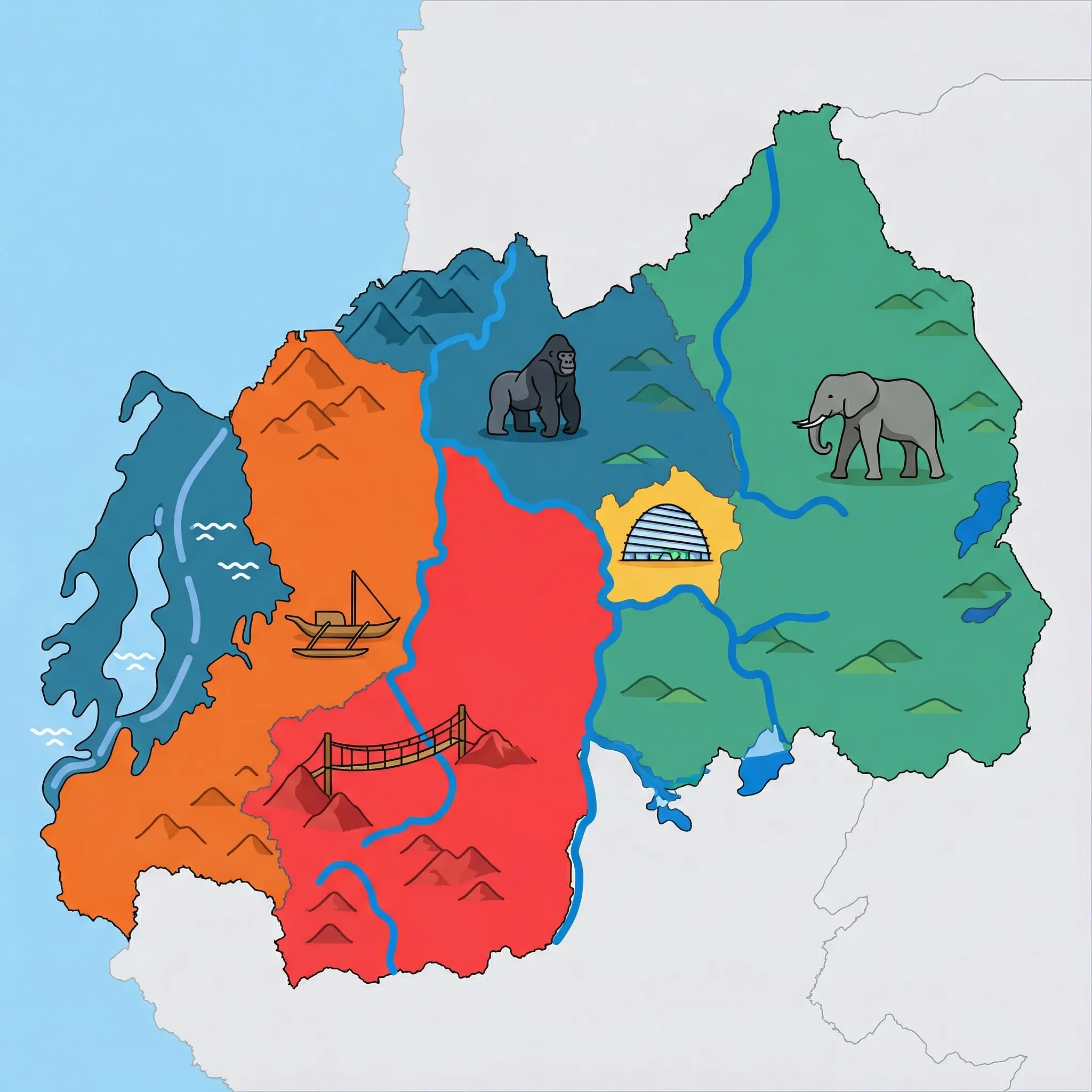
Click a region to explore
Overview
The Southern Province and Nyungwe Forest offer a journey into the heart of Rwanda's natural and royal heritage. Dominated by Nyungwe National Park, this region protects one of Africa's oldest montane rainforests. For families, entering Nyungwe feels like stepping onto a movie set—giant tree ferns, orchids, and troops of colobus monkeys moving through the trees create a magical atmosphere. While chimpanzee trekking here is often arduous and better suited for adults or teenagers, the forest offers plenty of milder hikes and waterfalls accessible to younger children.
Beyond the forest, the South is the cultural custodian of Rwanda. The towns of Nyanza and Huye (formerly Butare) were the seats of the traditional monarchy and the colonial intellectual hubs. The landscape is characterized by endless, manicured tea plantations that look like bright green carpets rolled over the hills. The climate is cooler and wetter than the east, often shrouded in a mystical mist that adds to the allure. It’s a place for active families who enjoy nature walks, history, and scenic drives, offering a quiet, contemplative contrast to the bustle of Kigali.
Key Attractions
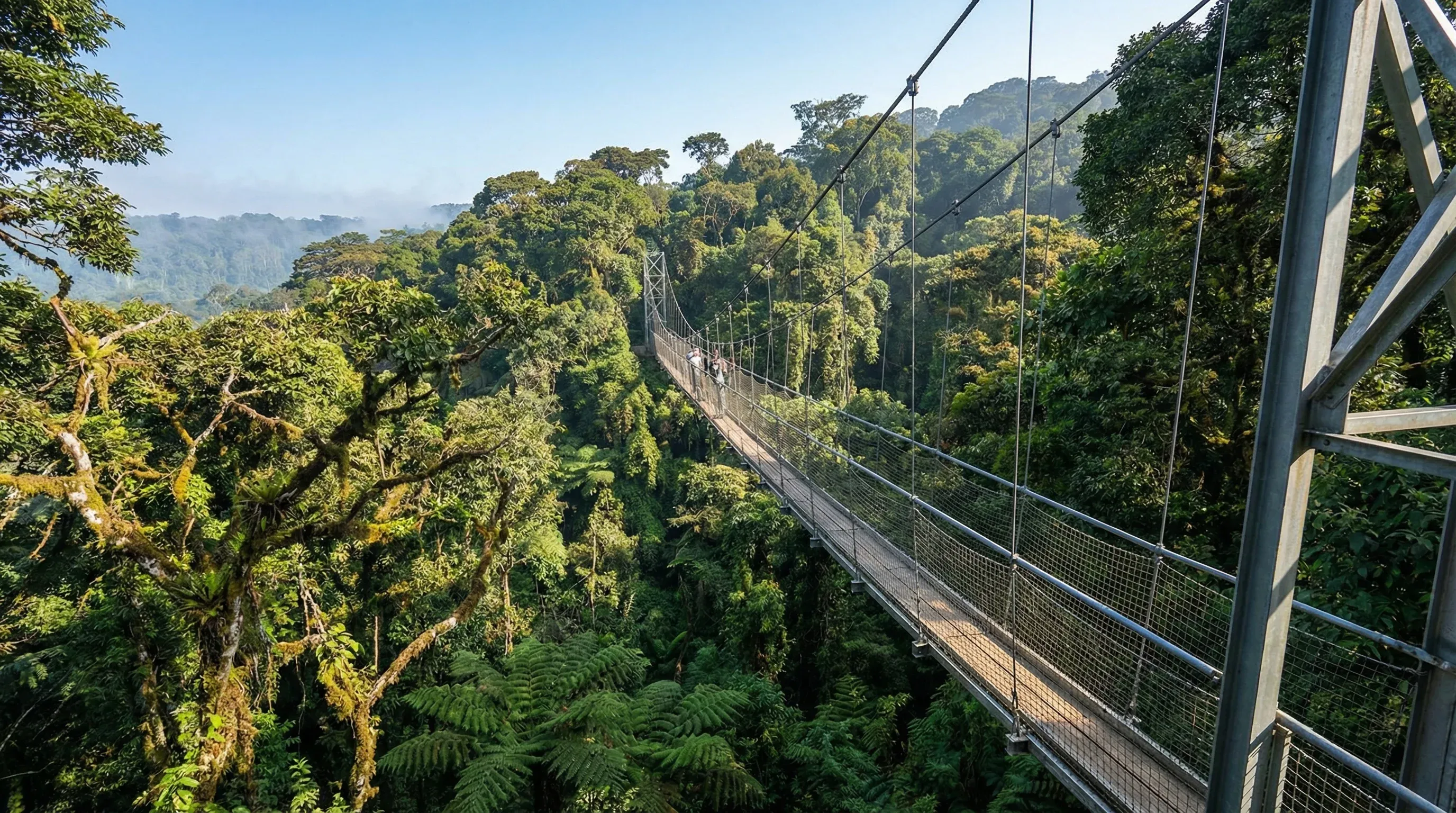
The absolute highlight for adventurous families is the Canopy Walkway in Nyungwe National Park. Suspended 70 meters above the forest floor, this bridge offers bird’s-eye views of the jungle. Note that children must be at least 6 years old to participate. For a cultural deep-dive, the Ethnographic Museum of Rwanda in Huye is the best museum in the country, housing a rich collection of traditional artifacts, basketry, and architecture that brings pre-colonial history to life.
In nearby Nyanza, the King's Palace Museum (though not in our link list, it's a key neighbor to the Ethnographic Museum) features traditional royal cows (Inyambo) with massive horns that are sung to by their keepers—a spectacle that fascinates children. The tea plantations bordering the forest also offer tours where families can learn how tea is picked and processed.
Practical Advice
Nyungwe is a rainforest, so rain is possible year-round; waterproof gear is non-negotiable. The drive from Kigali is long (5-6 hours) and winding, so plan stops in Nyanza or Huye to break up the journey. The forest is at high altitude, so evenings are chilly.
Food & Drink
Typical meal times: Lunch 12:30 pm to 2:00 pm. Dinner 7:00 pm to 9:00 pm.
Typical meal costs: Meals at high-end lodges near the park are expensive, around 25,000–40,000 RWF (approx. $20–32 USD / €18–30 EUR). In Huye town, good meals cost 5,000–10,000 RWF (approx. $4–8 USD / €3.75–7.50 EUR).
Dietary requirements: Lodges cater well to international diets. In Huye, you can find excellent dairy products (yoghurt, cheese) as it's a dairy-producing hub.
Signature dishes:
- Maracuja (Passion Fruit) – The region produces incredible passion fruit, often served as fresh juice or dessert.
- Matoke – Plantains steamed in banana leaves, a staple carbohydrate that is mild and kid-friendly.
- Sombe – Cassava leaves, frequently served as a side dish in Huye buffets.
Why this score?
This region features dense, ancient rainforest with rugged hiking trails and a high-altitude canopy walkway that can be physically demanding. The unpredictable weather and steep terrain of the forest provide a significant outdoor challenge for visiting families.
Why this score?
Outside of the university town of Huye, medical infrastructure is very sparse and difficult to access within the deep forest areas. Emergency response times can be slow due to the winding mountainous roads and the distance from advanced facilities.
Why this score?
Nyungwe is an emerging destination famous for chimpanzees and its canopy walk, but it remains a niche interest compared to gorilla trekking. The southern cultural sites in Nyanza and Huye receive moderate traffic but are rarely the primary reason for an international visit.

Accommodation options are polarized: ultra-luxury lodges cost $1,500+ USD per night, while comfortable guesthouses and mid-range hotels in the Gisakura area cost 80,000–150,000 RWF (approx. $65–120 USD / €60–110 EUR). Park activities have set fees; the Canopy Walk is roughly $60 USD per person.

Getting Here & Around
Getting Here
- Driving – The drive from Kigali to Nyungwe takes 5–6 hours via Huye. The road is paved and in good condition but very winding.
- Bus – Buses run from Kigali to Huye and Rusizi (passing through the forest), but for park activities, a private car is essential to reach trailheads.
- Air – RwandAir operates flights to Kamembe Airport (Rusizi), about 45 minutes drive from the western edge of the park.
Getting Around
- Car – Essential for moving between your lodge and the various trailheads of Nyungwe National Park.
- Walking – This is a hiking destination; bring sturdy boots. The trails are well-marked but can be slippery.
No airports in this region. See the country flight map for nearby connections.
Official Links

Packing List
It is a rainforest; downpours are sudden, heavy, and frequent.
Keeps mud and safari ants out of your boots on forest trails.
The forest is at altitude and mornings/evenings are surprisingly cold.
The roads leading to and through the park are famously twisty.
Plastic bags are strictly banned and confiscated at the airport; pack reusable totes for shopping and laundry.
Essential for grabbing stinging nettles and thorny branches during jungle treks or nature walks.
Prevents safari ants and mud from entering your boots during forest hikes in Nyungwe or Volcanoes NP.
Rwanda is the 'Land of a Thousand Hills'—roads are endlessly winding and can affect kids easily.
Mornings in the mountains (Volcanoes/Nyungwe) are surprisingly cold (10°C/50°F) despite being near the equator.
Physical proof of vaccination is often requested at the airport border control.

Activities & Best Times

Hiking, wildlife, outdoor exploration, ecotourism
Home to one of Africa's oldest rainforests, offering world-class chimpanzee trekking and an iconic canopy walk. Peak dry seasons (June-August, Dec-Jan) ensure accessible trails and the most reliable conditions for primate sightings.

Urban tourism, museums, historical sites, architecture
The cultural heartland of Rwanda, featuring the authentically reconstructed King's Palace at Nyanza and the high-quality Ethnographic Museum in Huye. Drier months are preferred for exploring these outdoor heritage sites and transit between the cultural hubs.

Learning experiences, scientific sites, historical education
The classification notes describe the Ethnographic Museum as 'nationally significant' and providing 'deep insights' into Rwandan culture. This contradicts a 'marginal' rating. A nationally significant museum warrants 'good' at minimum.

Scenic drives, countryside tours, route-based travel
Boasts spectacular scenic drives through high-altitude tea plantations and dense rainforest on the RN6. Dry seasons offer the safest driving conditions and the clearest vistas over Rwanda's 'thousand hills' and towards Lake Kivu.

Sport tourism, fitness activities, active recreation
Offers the challenging start of the Congo-Nile Trail and high-quality forest trekking routes like the Isumo Waterfall trail. Heavy rains in April and November can make these steep, muddy trails difficult and are best avoided for active sports.

Spa retreats, wellness centers, peaceful getaways
Features the Mashyuza Hot Springs, though facilities are basic and lack the luxury infrastructure typical of global wellness destinations. Best visited in dry months when outdoor bathing is most comfortable and accessible.




Public Holidays & Calendar Next 12 months
Public holidays, festivals, cultural celebrations, and seasonal natural phenomena coming up in Nyungwe Forest & South over the next 12 months.
Loading holidays and events...

Travel Advisory
While half of the major agencies consider Rwanda safe for standard travel, the other half recommend increased caution due to persistent regional tensions and border risks. This split assessment suggests a need for heightened situational awareness.
Safety Topics
Traveller Advice (3 groups)

Rwanda is generally considered safe for women, including solo travellers; however, standard precautions should be taken when walking alone at night, and conservative dress is often respected in rural areas.

While consensual same-sex acts are not criminalized and discrimination is constitutionally prohibited, local society remains conservative. Public displays of affection may attract negative attention or harassment.

Visitors should always carry identification, follow local authority directives, and avoid night-time travel outside of major urban centers. It is recommended to stay informed through local media regarding border status.
Agency Summaries
Travellers should maintain standard safety awareness throughout the country, though specific border regions require significantly higher vigilance.
The general security environment is stable, though conflict in neighboring DRC may occasionally impact safety near the western border.
A high level of vigilance is advised because of the volatile situation in the wider Great Lakes region and potential for rapid changes in security.
Travellers should remain alert in public spaces and monitor border conditions which can deteriorate with little warning.
Increased caution is recommended due to potential armed violence, particularly in districts bordering the Democratic Republic of the Congo.
No country-wide warnings are in place, but visitors are advised to avoid certain border areas due to regional instability.
Information is provided for general guidance only and does not constitute travel, safety, medical, or legal advice. Conditions may change. Users are responsible for independently verifying information before travel.