
Click a region to explore
Overview
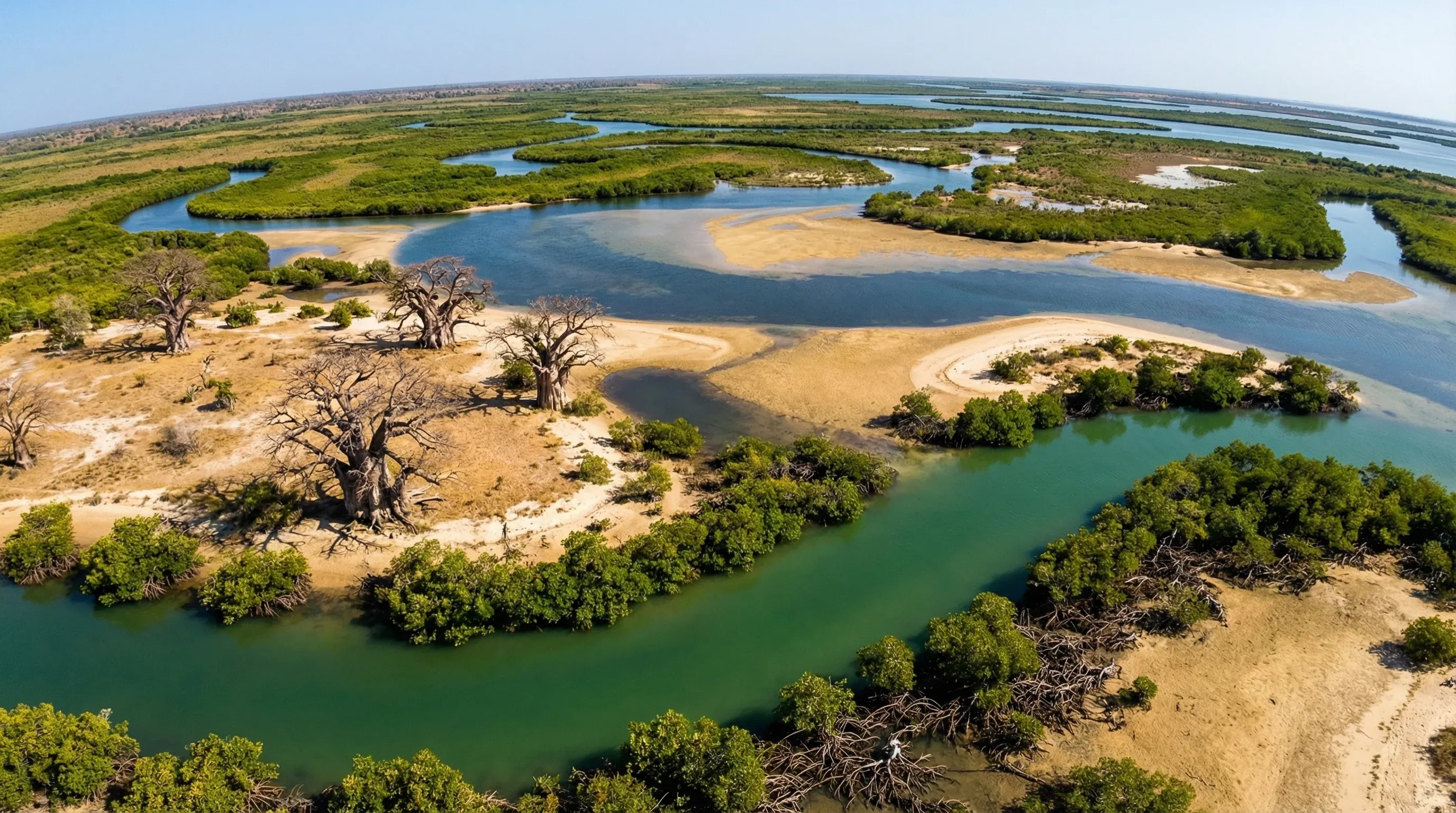
The Sine-Saloum Delta is one of the most beautiful and ecologically diverse landscapes in West Africa. Where the Sine and Saloum rivers meet the Atlantic, a vast labyrinth of mangrove forests, saltwater creeks, and sandy islands is formed. For families who love nature, this is the ultimate playground. Life here revolves around the water; days are spent on traditional pirogues exploring the channels, watching kingfishers hunt, and spotting monkeys in the trees.
This region offers a tranquil alternative to the busy beaches of the Petite Côte. Accommodation is often in eco-lodges that sit right on the water's edge. It provides a unique opportunity for children to learn about delicate ecosystems and traditional fishing cultures. South of the delta, near the Gambian border, drier forests offer land-based safari experiences that rival those in East Africa, making this region a "best of both worlds" destination.
Key Attractions
The headline attraction for adventurous families is the Fathala Wildlife Reserve. Here, they offer a "Lion Walk" experience (strict height/age restrictions apply) and guided game drives where you can see the rare Giant Derby Eland, giraffes, and zebras. It is a well-managed reserve that allows for close-up encounters.
The Saloum Delta National Park itself is the main star. Taking a boat at sunset to roosting islands where thousands of birds gather is magical. You can also visit Fadiouth Shell Island (accessible from the north of the delta), where the ground is paved with millions of clam shells.
Practical Advice
Travel here involves both road and boat. It takes about 4-5 hours to reach the heart of the delta (Toubacouta) from the airport. Insect repellent is mandatory here due to the mangroves. The area is generally very safe and peaceful.
Food & Drink
Typical meal times: Lunch 12:30 pm to 2:30 pm; Dinner 7:30 pm to 9:30 pm. Most visitors eat at their lodges as restaurants are scarce in remote villages.
Typical meal costs: Dining is usually included in lodge full-board rates. If paying separately, expect 8,000–12,000 XOF (approx. $13–20 USD / €12–18 EUR) per meal.
Dietary requirements: Lodges are used to international guests and can cater to allergies if notified in advance. Local village food is almost exclusively fish and rice.
Signature dishes:
- Huîtres de Palétuviers (Mangrove Oysters) – Small, sweet oysters harvested directly from the mangrove roots. They are often grilled over wood fires.
- Poisson Braisé – Whole fish grilled over charcoal, usually served with lime and onion sauce.
- Couscous de Mil – Millet couscous, a staple grain in the Serer culture of this region, often served with a fish sauce.
Why this score?
The delta's labyrinth of mangroves and salt flats requires boat-based transport, creating a sense of isolation and adventure for families. Navigating the tidal waterways and visiting remote shell islands like Fadiouth offers a moderately rugged outdoor experience.
Why this score?
Medical facilities in the delta are extremely sparse, with only basic rural health posts available in towns like Toubacouta. Emergency evacuation to Dakar is difficult and time-consuming due to the water-based geography and distance from the capital.
Why this score?
This region is a niche destination favored by birdwatchers, anglers, and those seeking quiet eco-lodges away from the crowds of Saly. While highly regarded for its natural beauty, its limited hotel capacity and slower pace result in lower overall international visitor numbers.

Costs depend heavily on accommodation choice. Eco-lodges range from basic camps to luxury tents. A mid-range lodge costs 45,000–80,000 XOF (approx. $75–130 USD / €68–120 EUR) per night. Boat excursions are an extra cost, typically 20,000–40,000 XOF (approx. $33–66 USD / €30–60 EUR) for a half-day private rental.

Getting Here & Around
Getting Here
- Driving – The main route is via Mbour and Fatick. The roads are generally good tarmac until the final stretches to specific lodges.
- Ferry – If coming from Dakar to the southern part (Toubacouta), the route is entirely by road; no major ocean ferries serve this specific delta route.
Getting Around
- Pirogue (Canoe) – The primary mode of transport within the Saloum Delta National Park. Motorized pirogues move between islands and villages.
- Car – Necessary for reaching Fathala Wildlife Reserve from the delta lodges.
- Walking – Great for exploring the small villages, but distances between towns are too far to walk.
No airports in this region. See the country flight map for nearby connections.
Official Links

Packing List
Many eco-lodges run on solar power and paths can be very dark at night.
Mangroves are breeding grounds for mosquitoes and midges; essential for evenings.
Birdlife in the delta is spectacular; you will regret not having them on boat trips.
You will be on small boats often; protects cameras/phones from splashes.
Power cuts are common even in hotels; red light keeps bugs away.
Hotel nets often have small holes; a needle and thread or patches ensure safety.
English is rarely spoken outside major hotels; basic French is essential for drivers.
Essential for spotting wildlife at Bandia and birds at Djoudj.
Useful for wet bathrooms and dusty, sandy streets where shoes are removed often.

Activities & Best Times

Hiking, wildlife, outdoor exploration, ecotourism
A UNESCO Biosphere Reserve offering unique mangrove ecosystems and the Fathala Wildlife Reserve for family-friendly safaris. Peak season offers optimal conditions for birdwatching and wildlife viewing when the weather is dry and temperatures are manageable.

Urban tourism, museums, historical sites, architecture
Home to the unique shell-island of Fadiouth and ancient shell middens, providing deeply authentic West African heritage. Best visited during the dry season to comfortably explore the car-free islands and attend local community gatherings.

Beach resorts, marine activities: diving, snorkelling, kite surfing, wind surfing, sailing
Features tranquil estuarine beaches and sandbars around Palmarin and Mar Lodj island, ideal for calm-water exploration. The experience is best when humidity is low and water visibility is high during the dry months.

Scenic drives, countryside tours, route-based travel
The Palmarin Peninsula and the crossing at Foundiougne offer spectacular scenic driving routes through delta landscapes. Off-season travel is discouraged as heavy rains can make unpaved regional roads difficult to navigate for families.

Sport tourism, fitness activities, active recreation
Offers excellent flat-water kayaking through bolongs and established hiking trails like the Giraffe Trail. Activity levels are highest in the cooler winter months; summer heat and humidity make intensive physical activity uncomfortable.

Learning experiences, scientific sites, historical education
The Saloum Delta Interpretation Center (CIDS) provides context on the region's environmental and cultural history. While significant, it is a secondary attraction to the natural and cultural sites themselves.




Public Holidays & Calendar Next 12 months
Public holidays, festivals, cultural celebrations, and seasonal natural phenomena coming up in Sine-Saloum Delta over the next 12 months.
Loading holidays and events...

Travel Advisory
The majority of international agencies recommend exercising a high degree of caution throughout Senegal. While the country is generally stable, risks from street crime, civil unrest, and regional instability near borders warrant increased vigilance.
Safety Topics
Traveller Advice (5 groups)

Be aware that quality medical facilities are largely concentrated in the capital, Dakar. Access to specialized healthcare is extremely limited in rural and inland regions.

Local customs are conservative; it is recommended to dress modestly and avoid walking alone after dark, particularly in isolated areas.

Ensure you have comprehensive travel insurance that covers medical evacuation. Register your travel plans with your national consulate and maintain a high level of personal security awareness in public spaces.

Same-sex relations are criminalized and can lead to imprisonment. Societal discrimination is significant, and discretion is advised as public displays of affection may attract negative attention or legal consequences.

Extreme caution is required in remote border regions near Mali and Mauritania, where there is a documented risk of kidnapping by extremist groups targeting Westerners.
Agency Summaries
A high level of caution is advised because of the risk of civil unrest and common crime. Public health concerns also exist, including a reported outbreak of Rift Valley Fever in multiple regions, including Dakar.
Visitors should be particularly alert to street crime in urban areas like Dakar. It is recommended to avoid travel within 25 kilometers of the borders with Mali and Mauritania due to the threat of extremist activity and kidnapping.
The overall security situation is stable, but there is an underlying threat of terrorism and potential for civil unrest. Authorities advise against travel to certain border regions and the Casamance province due to ongoing security risks.
Travellers should remain highly vigilant due to prevalent crime. There are specific regional warnings advising against non-essential travel to the Casamance region (excluding Ziguinchor and Cap Skirring) and areas near the border with Mali due to security concerns.
Increased vigilance is required due to the risk of violent crime, including armed robberies, and the frequency of public demonstrations that can turn violent. Regional restrictions are in place for the eastern border and Casamance.
While the country is generally safe, visitors should be aware of heightened risks in certain areas. Increased caution is recommended in the Casamance region due to crime and the presence of landmines. Avoid showing signs of wealth to minimize the risk of petty theft.
Information is provided for general guidance only and does not constitute travel, safety, medical, or legal advice. Conditions may change. Users are responsible for independently verifying information before travel.